Common Waterbuck
Kobus ellipsiprymnus
Description, Habitat & Distribution
Lifestyle, Behaviour & Social life
Communication
Diet
Reproduction & Lifestyle
Did you know?
Folktales & Traditional Stories
Description
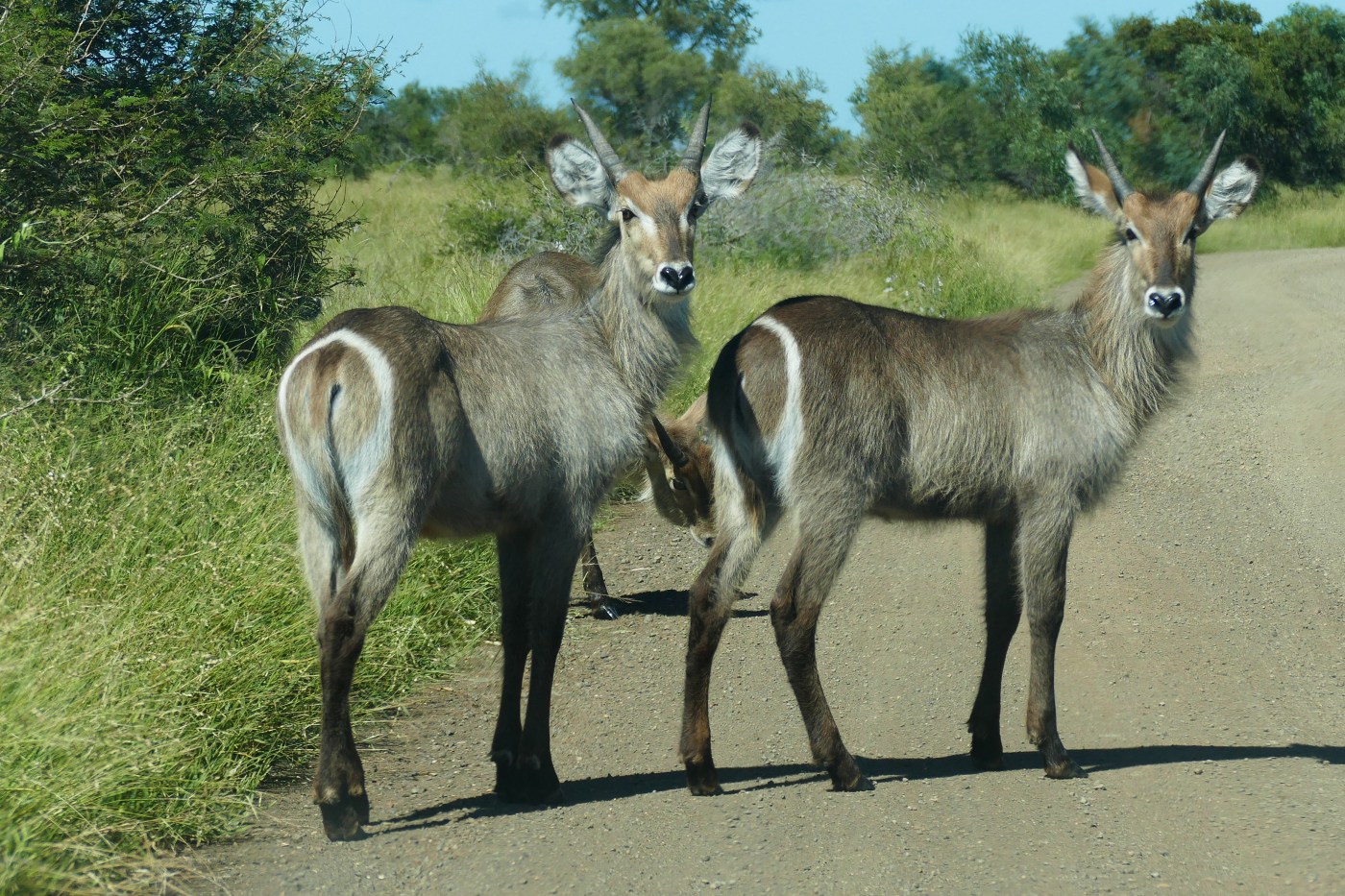
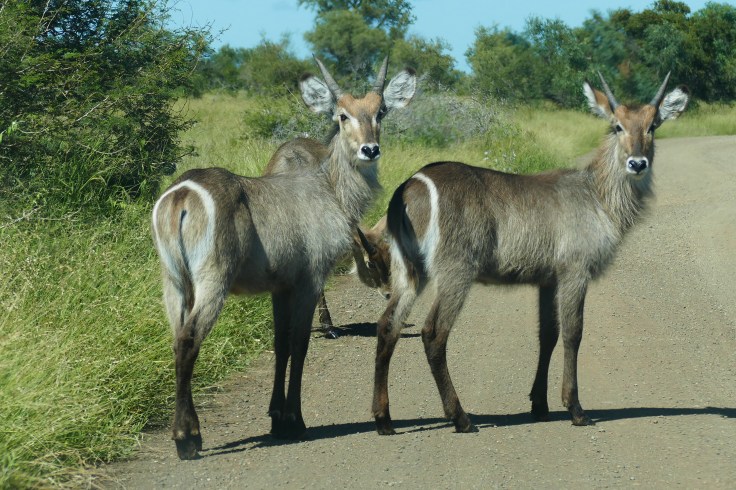
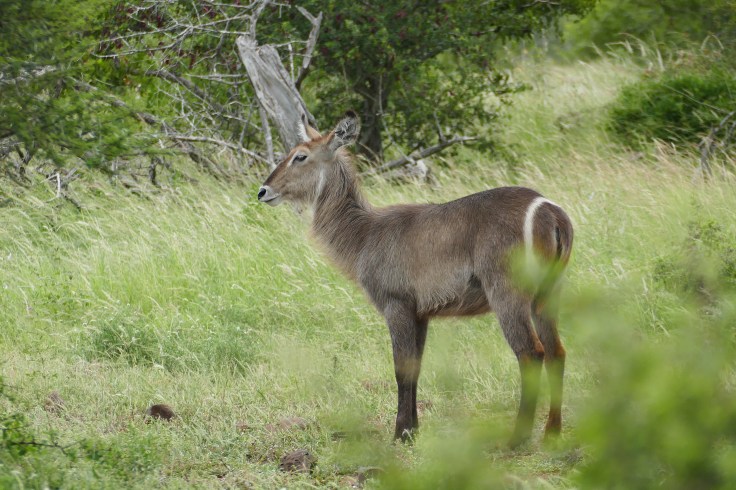
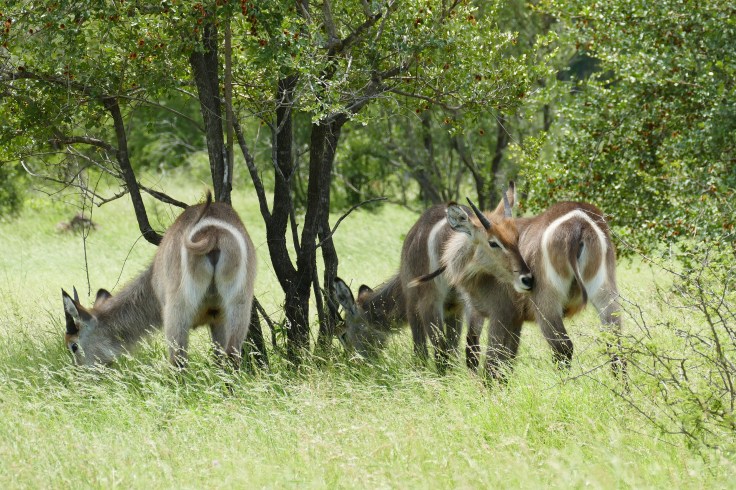
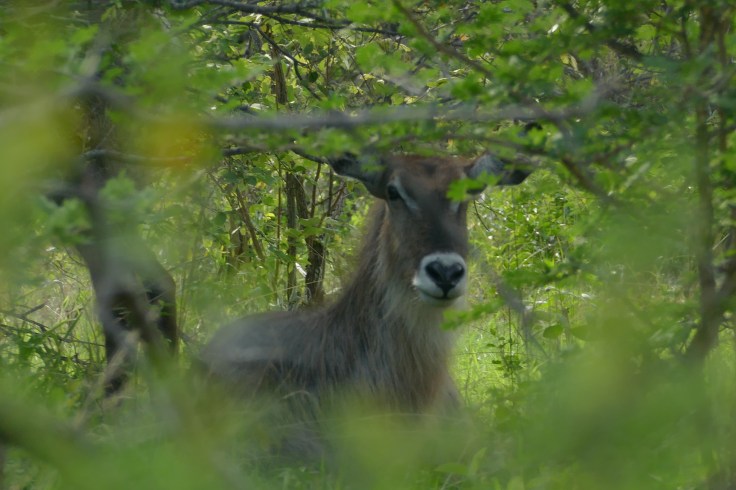
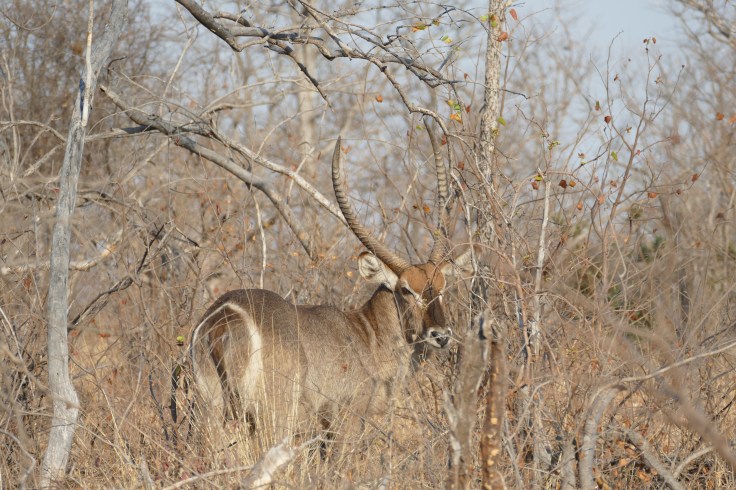
The waterbuck is a heavy, robust antelope with a stocky build and short, stocky legs, grey in colour with a white collar on the throat and a distinctive white ring on the rump.
The hair looks long and rough, the coat is coarse and shaggy.
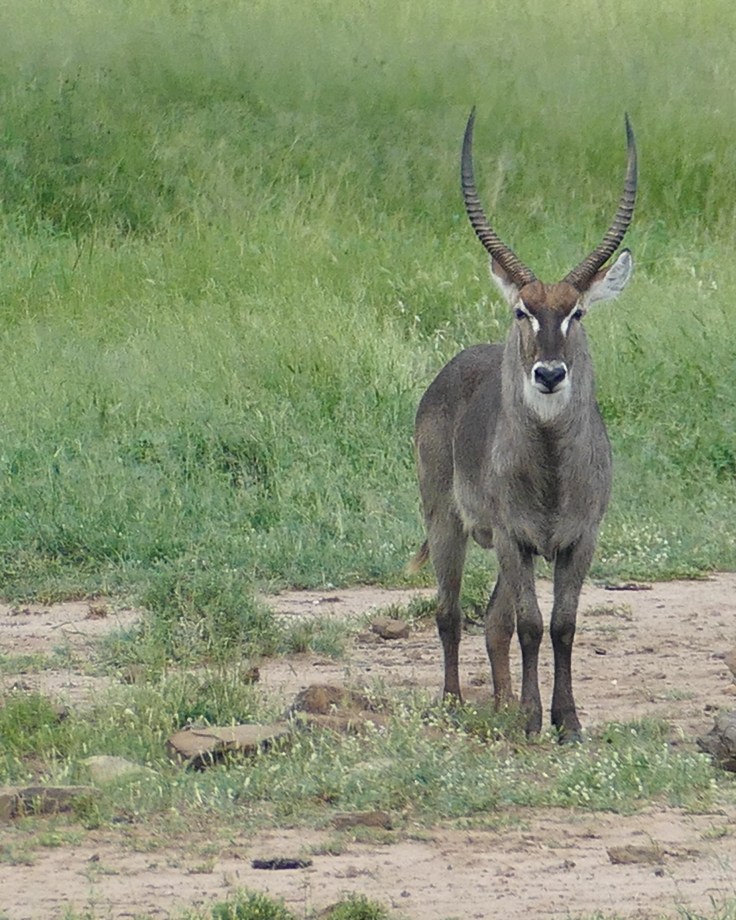
The nose is black and heart-shaped nose, surrounded by white.
Sexual dimorphism
The waterbuck is a sexually dimorphic antelope.
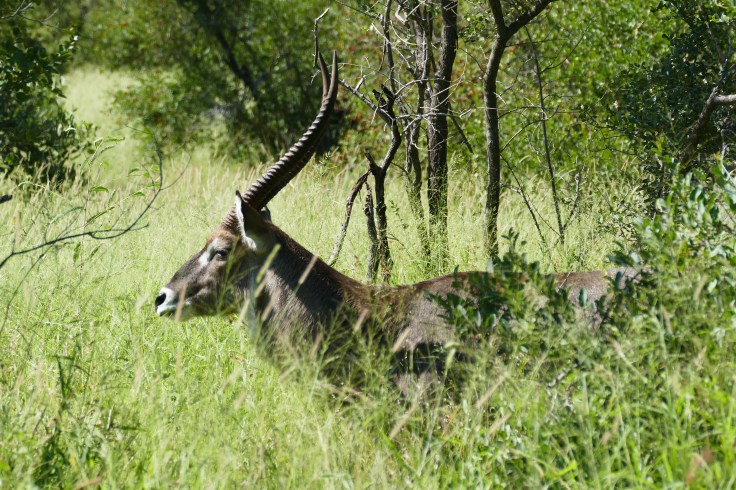
Males are larger and heavier and have horns which are heavily ringed and arc-shaped.
Habitat
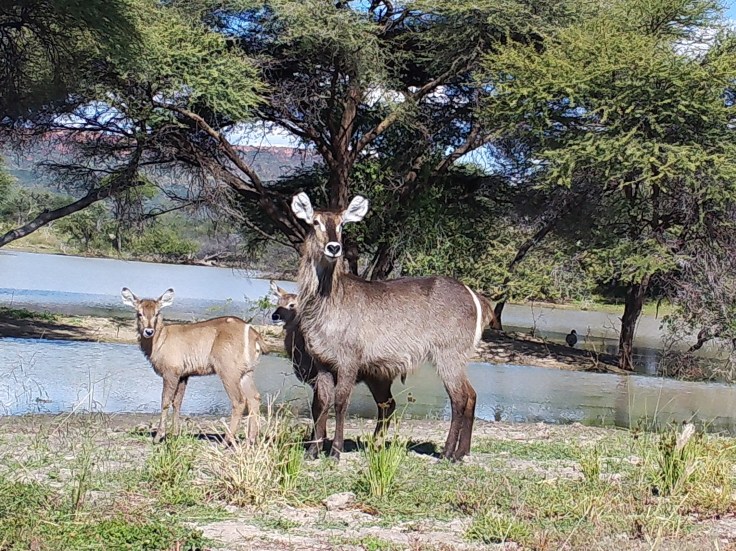
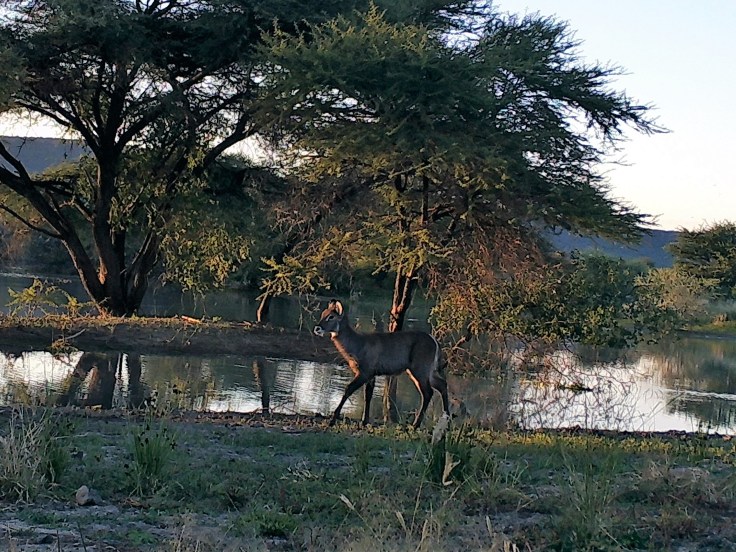
Prefers floodplains, savannah clearings, reedbeds, open woodland. Always relatively close to water.
Distribution
Northern parts of South Africa, Kwa-Zulu Natal, Limpopo and Mpumalanga. Widespread in Zimbabwe and northern parts of Botswana.
Lifestyle, Behaviour & Social Life
Gregarious
Territorial
Diurnal
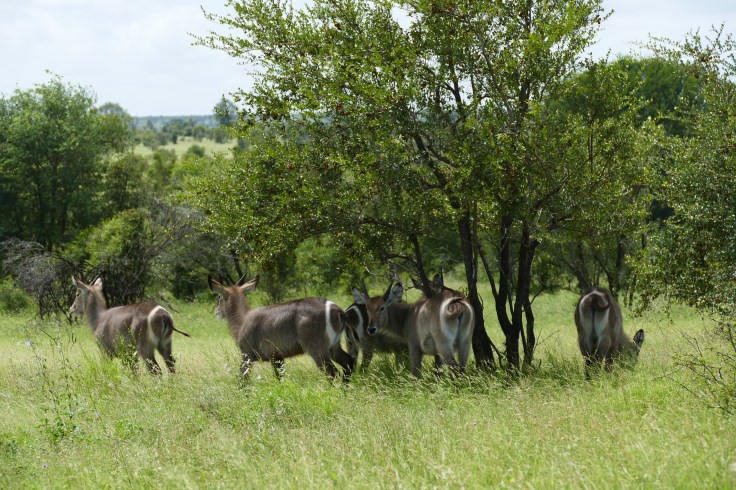
Waterbucks live in sex-separated herds – either nursery or bachelor herds – with an average of 6 to 12 members. Dominant males live solitary.
Young males form bachelour groups from the age of 8-9 months, when their horns emerge and the territorial bull chases them out of the nursing herd. Mature males (5-10 yrs) are territorial and solitary. Territorial bulls will usually not act agressively towards bachelour bulls that come into their territory, especially if they stay submissive (head low and walking with a cringing posture). This depends on the individual, some bulls are very strict whereas others will even accept young bulls that helps with territorial defence, but they do not tolerate other dominant bulls.
A territorial male advertises his status by standing erect and “proud” with his head high and tail extended. In case of combats horns are locked and pushed while attempting to gore the opponent´s flanks. Deaths are common.
During breeding season, territorial bulls dominate groups of females and their young and can often be seen moving around together.
Antipredator behaviour
If a potential predator is spotted, the waterbuck will usually stand still or hide in bushes or tall grass while watching the threat carefully. They would wait until the last moment, but then they flee, often changing directions suddenly or sharply to outrun an outmanouvre the attacker. During their flight, they periodically stop to have a look back.
Communication
Sound (Vocal) | Olfactory (Scent) | Visual
They use body posture to advertise their status. Dominant bulls will stand tall with head held high and horns up, submissive males will lower their head with the horns back.
The scent also plays a role in communicating status, with the larger, more dominant males having a stronger musky odour that is released by their skin glands. The secret from the glands is also supposed to help them with waterproofing the coat. The white ring on the rump serves as a follow me sign for herd members follow each other when they run away from a potential threat.
Reproduction & Lifecycle
Gestation: 9 months
No of young: 1 (occasionally 2)
Weaning: 6-9 months
Sexual maturity: 2 years, males only at 5-6 years
Lifespan: 11-15 years
Dominant males will start “herding” a female group once they walk through his territory.
Courtship behaviour: Males stimulate females to urinate, sniffs the female´s rear, rubs his face on her and sometimes even pushes her with forehead and horns. If receptive, the female acts skittish, tosses her head and champ and stands in swan-neck posture.
After a gestation period of 9 months, usually one calf is born (twins occur occasionally). The cow will isolate herself when giving birth.
Calves will be kept way from the herd for 2-4 weeks. The first weeks the mothers come about three times per day to suckle them but then forages alone. After about a month, the calf starts wandering around alone or with their mom. To encourage the calf to follow, the mother holds her tail up or out. Calves can be seen wandering around alone or in small youngster groups.
Diet
Herbivorous (Grazer)
Waterbuck eat on a variety of grasses, both medium and short and they will feed on herbs and leaves if grass is sparse. Waterbuck are very water dependent and stay within a range of 2 km of it. The Waterbuck has a short rumination due to high water intake and fresh food.
Often hunted by lion. In certain parts of the Kruger Park it has been found that they are the preferred prey species for lions. Often hunted by lion. In certain parts of the Kruger Park it has been found that they are the preferred prey species for lions.
Did you know?
The waterbuck is one of the most water-dependant antelope and are very susceptible to dehydration.
Will run into water to escape predators but does prefer dry ground.
Males will fight off predators.
Fights between territorial males are fierce and more commonly fatal than in other antelope.
The nose of a Waterbuck has the same shape as the track.
The skin secretes an oily substance with a storng musky smell. The purpose of the secretion is to provide the coat with a water repelling characteristic. This is important for an animal that often seeks out water and will wade into deep pools, to escape from predators.
The hair on the neck is thick, long and hollow. Another one of the animal’s adaptations and helps with the buoyancy when the animal goes into deep water.
It has long been believed that the skin secretion also affects the taste of the meat and that the waterbuck is therefore not often preyed on, but several studies in the Kruger National Park revealed that the waterbuck is the preferred prey species for lions in certain parts of the park.
The Botswana people call it “Serwala botloko”, the carrier of pain. When a sick person touches a living waterbuck (especially on the rump), the waterbuck would take away the pain. Waterbucks were caught for this purpose but when they got hurt, it was believed that the sick person would die of the sickness. Read more …
Called “kringgat” in Afrikaans, meaning “circle bottom”.
Top speed: 50 km/h.
Folktales & Traditional Stories
Serwala botloko, the carrier of pain
How the Waterbuck got its ring
Praise song to the Waterbuck

 Sininho´s World
You must be logged in to post a comment.