Steenbok
Raphicerus campestris
Description, Habitat & Distribution
Lifestyle, Behaviour & Social life
Communication
Diet
Reproduction & Lifestyle
Did you know?
Description
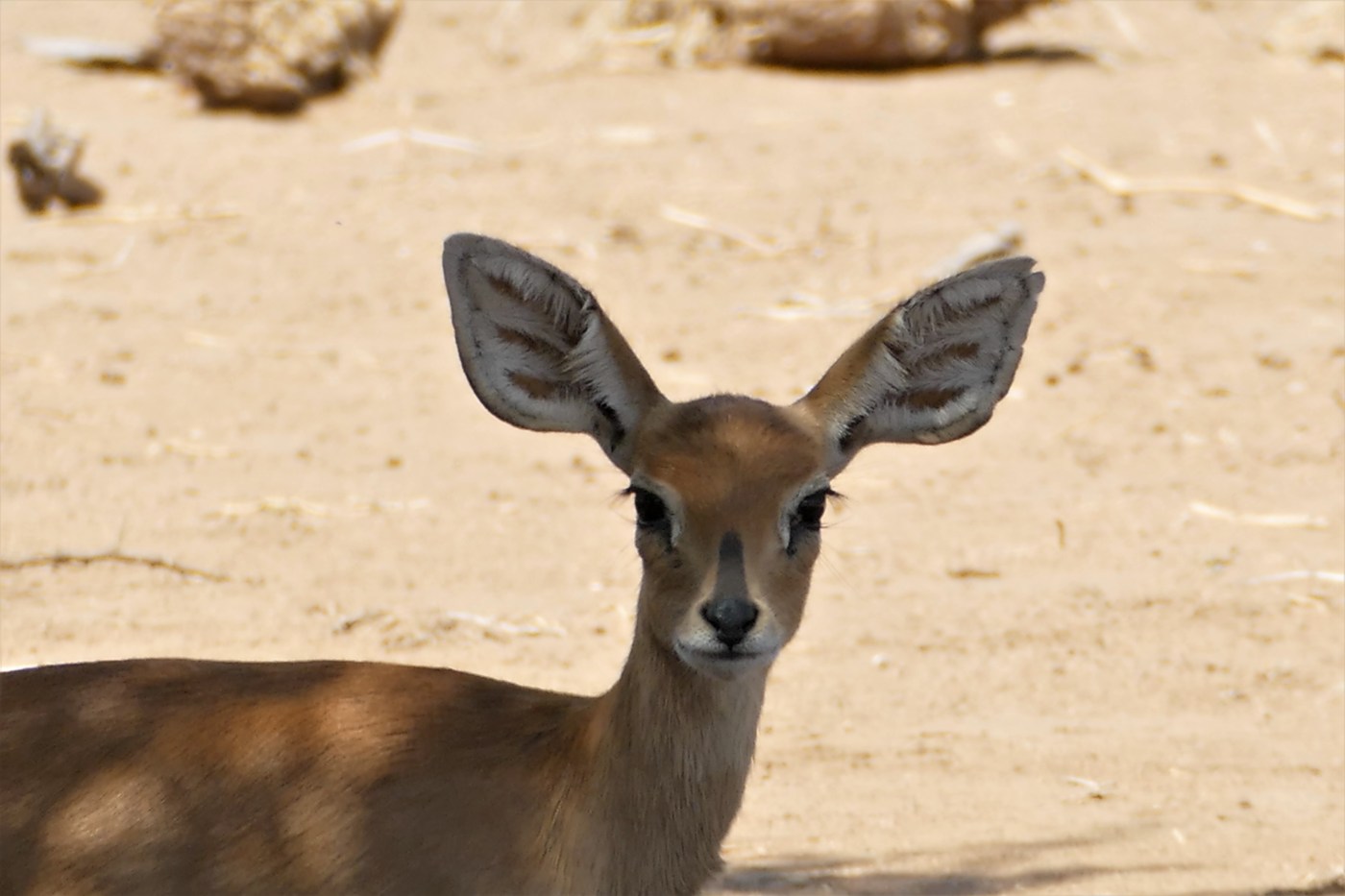
We are small antelopes of just over 50 cm. Our body is mostly a reddish-brown colour with a white belly. We have huge and very distinctive ears and prominent preorbital glands opening in slits in front of our large and beautiful eyes.
We females are slightly bigger than the males. Only the males have straight little horns.
Habitat
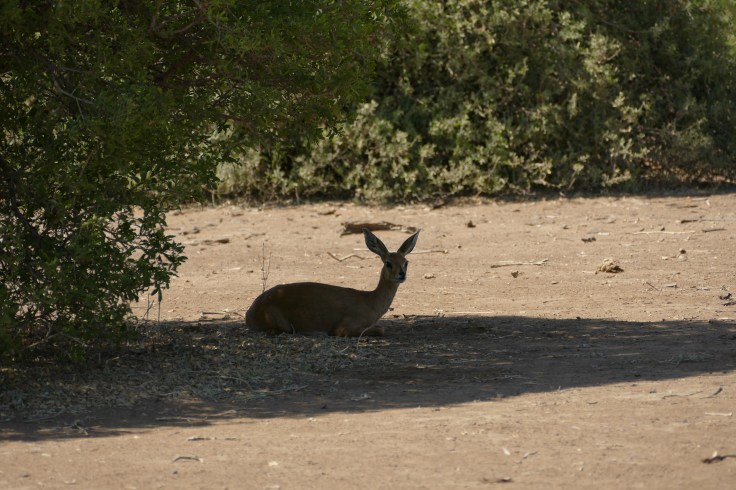
Grassland with tall grass or bushes for cover.
Distribution
There are two distinct distribution clusters: In East Africa (central and southern Kenya and northern Tanzania) and Southern Africa (Angola, Namibia, South Africa, Eswatini, Botswana, Mozambique, Zambia, Zimbabwe and probably Lesotho).
Lifestyle, Behaviour & Social Life
Solitary
Territorial
Nocturnal & Diurnal
We are generally solitary animals, but we – males and females – often keep adjacent and overlapping territories and we therefore tend to spend time together, but the pair-bond is by no means strong. Beliefs that we pair for life have been researched and life-long pairs are probably a result of our habitat, lack of alternatives, or we simply share the same territory and are therefore seen together quite often.
We are mostly active during the day but will feed in the night as well.
To mark our territory, we leave urine and dung along the borders, although we are one of the few species, that does not present our dung in obvious middens, such as other antelopes, but we cover our dung instead. Scraping and burying the dung prolongs the period in which the dung or urine spot stays moist, and with this behaviour, the scent is preserved.
If a predator is spotted, we usually stand still or hide in bushes or tall grass, but we are always ready to sprint way.
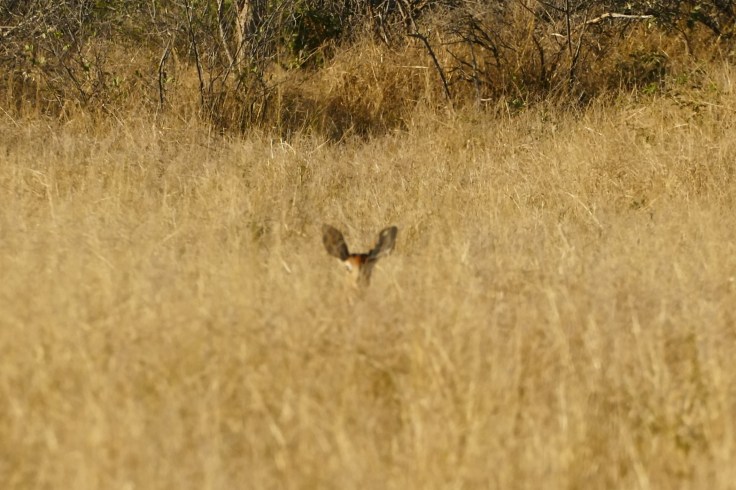
We wait until the last moment, but then we flee in a zigzag sprint, often changing directions suddenly or sharply to outrun the attacker. During our flight, we periodically stop to have a look back.
Instead of running, we sometimes hide in burrows of other animals to get away from a threat.
Communication
We steenboks are rather silent and communicate with each other by touch or chemicals. We have preorbital glands in front of the eyes, pedal glands in-between hooves and throat glands. By rubbing our head and throat against bushes or scraping with our hooves, we distribute the scent. Scent for us is like a messenger. We not only make clear who´s territory this is, but we can also smell who was around and we females leave information if we are in oestrus and ready to mate.
In case of invaders, we take on a raising posture and stamp with our legs.
Reproduction & Lifecycle
Gestation: 5.5 months
No of young: 1
Weaning: 3 months
Sexual maturity: 6 months
Lifespan: 8 years
We steenboks start mating as soon as we reach sexual maturity.
To find out if we are in oestrus, males with sniff the urine of us females. Approximately 5 ½ months after successful mating, we give birth to one fawn.
For the first three to four months, we hide our lambs, and we mothers only make contact in the early morning and evening to feed and groom the infant. We groom and clean them extremely strict, to conceal the infant’s presence and keep it as odour-free as possible. For the same reason we also eat the faeces and drink the urine of our offspring.
Weaning takes place after 3 months and another 3 months later, our youngs are sexual mature, although they would start reproduction usually with the age of 12 months. Often our offspring stays a while with us and we walk around as a family.
Diet
Herbivorous (Mixed feeders)
We are selective feeders; we eat a variety of grasses, leaves, flowers, fruits, and underground roots and bulbs. We prefer the young shoots of bushland trees and shrubs and easily digestible food. Our relatives in the Kalahari will additionally dig for bulbs and add melons to their diet.
We are water-independent and derive a lot of moisture from our food. Caracal, cheetah, jackal, hyena, leopard are their main predators, and in areas that we share with humans, we often fall prey to poachers´ dogs.
Did you know?
Steenbok will often burry their droppings by digging a hole with the forefeet, or soil will just be scraped over the dung. This leads to the scent from the dung staying on the hooves and as the animal walks around in his territory the scent will be spread, and the animal’s presence will be advertised to potential intruders.
When steenbok feel threatened, they will run away in zig-zag pattern with leaps in between. They will then stop suddenly and look back to see if the threat is following them, during this time they stand completely still like a stone (stone = steen in Afrikaans, where the name originated from).
The skin of the steenbok is strong and easily removed and was used by bushmen as bags or arrow quivers.
As you can imagine from the big ears, they have excellent hearing.
With their size of just above 50 cm, they belong to the “Dwarf antelopes”.
If you have a look into the sky on a moonless, cloud-free night, you will see two “clouds” in the south, one larger and brighter than the other one. We call them the “magellanic clouds”. The Ju/Wasi and !Kung Bushmen said that the larger cloud was a part of the sky where soft thornless grass grows, like the kind they used for bedding. One day, they say, God climbed onto the large cloud and went hunting. Several other Bushman groups saw the two clouds as male and female steenbok. (Source: http://www.marklives.com)

 Sininho´s World
You must be logged in to post a comment.