Greater kudu
Tragelaphus strepsiceros
Description, Habitat & Distribution
Lifestyle, Behaviour & Social life
Communication
Diet
Reproduction & Lifestyle
Did you know?
Folktales & Traditional Stories
Description
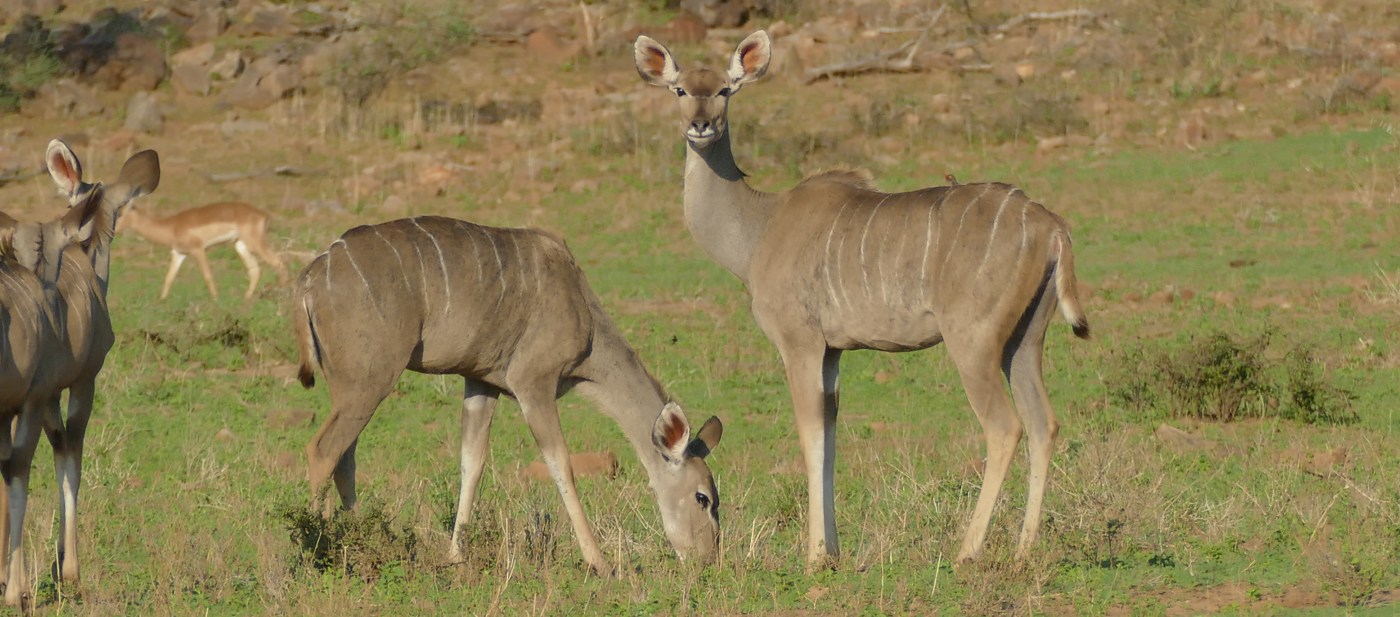
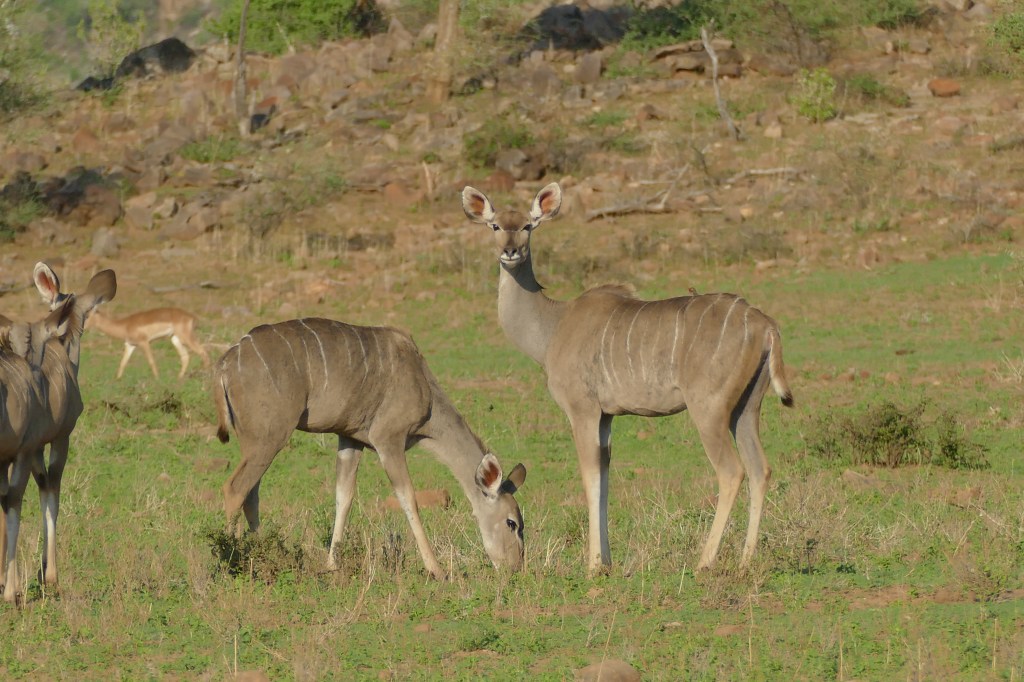
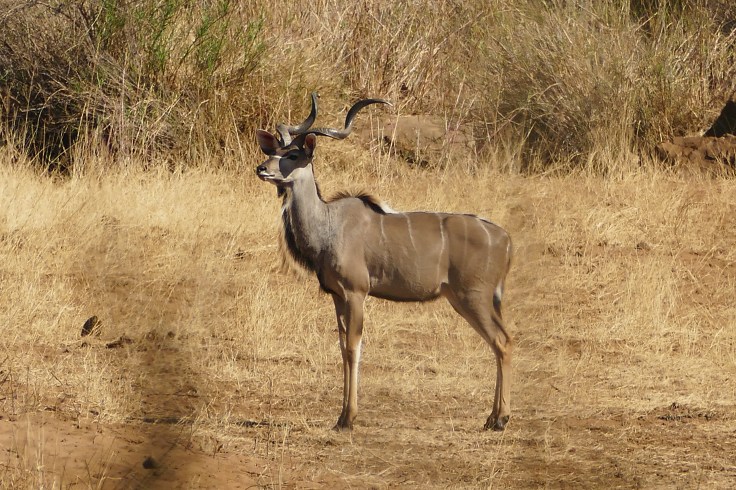
Kudus are tall and majestic antelopes with long legs and distinctive large ears.
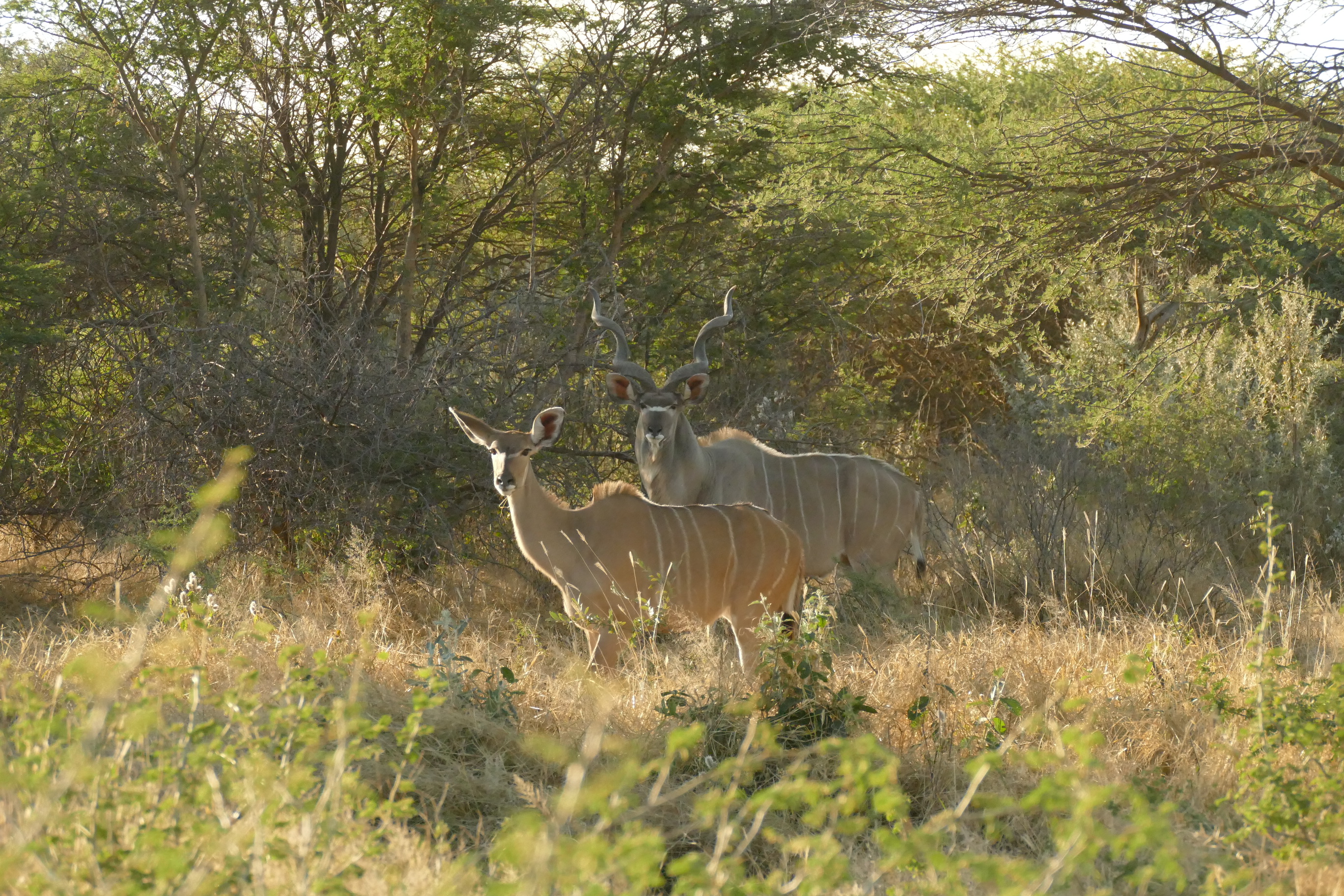
Males are fawn grey/brown while females have a warm cinnamon colour. 6-10 white vertical body stripes serve as disruptive markings: they cause a visual disruption of the shape and outline of the animal’s body which makes the animal less visible in the thicket and therefore better protected against predators. Because of this and its habit to be very silent, kudus are called the “ghost of the bush”.
Their face is in the same colour as the rest of the body, only the males´ is a bit darker.
Their large, radar-like ears are very distinctive for kudus and necessary as they live in thick habitat where hearing is essential.
They have a black nose, and a white colouration between upper lip and nose as well as on throat.
On both sides of their face are three elongated dots that reach from the ears to the jaw.
Both sexes have a white V-shaped stripe in-between the eyes that – especially in the males – creates a warrior-like look.
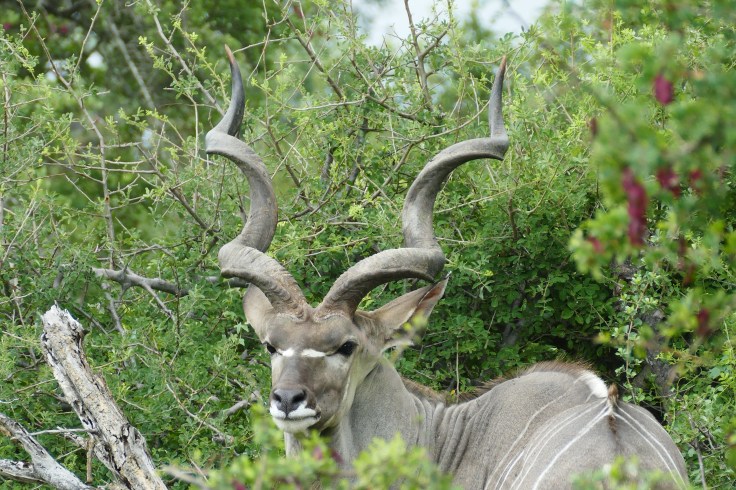
A short upright mane from the top of the head to the shoulders is grown in both sexes and males have in addition a long fringe of hair on their throat.
You do not see it on the first glance, but the tail is white underneath, which becomes only visible when the tail is lifted. This is used for communication, mainly as a “follow-me” sign, as well as anti-predator behaviour: when chased, the tail goes up when running away. The predator is focused on movement and follows the white sign and as soon as the kudu stops, the tail drops and the predator loses its target.
Typical for bushveld antelopes only males have horns. Kudus have large spiral horn. When fully grown, those horns have two and a half twists in them and can be as long as 1.2 m.
| Kudu horns can be used to estimate a kudu’s age: horns begin to grow at the age of 6 – 12 months, and by the age of 2 years, the horns have one twist. Fully grown males have two and a half twists in them. |
Sexual dimorphism
Males and females show a relatively high sexual dimorphism. Males have a long fringe of hair on their throat and large horns.
Males tend to be much larger and – interesting enough – more vocal than females.
Habitat
Savannah woodland, including rocky areas, succulent thickets, wooded hillsides.
Distribution
Eastern and southern Africa.
Lifestyle, Behaviour & Social Life
Gregarious
Non-territorial
Diurnal
Kudus feed early mornings and evenings to avoid the heat of the day but are occasionally seen at night as well. During the hot hours of midday, the do not move much and stand motionless and perfectly camouflaged in the thickets.
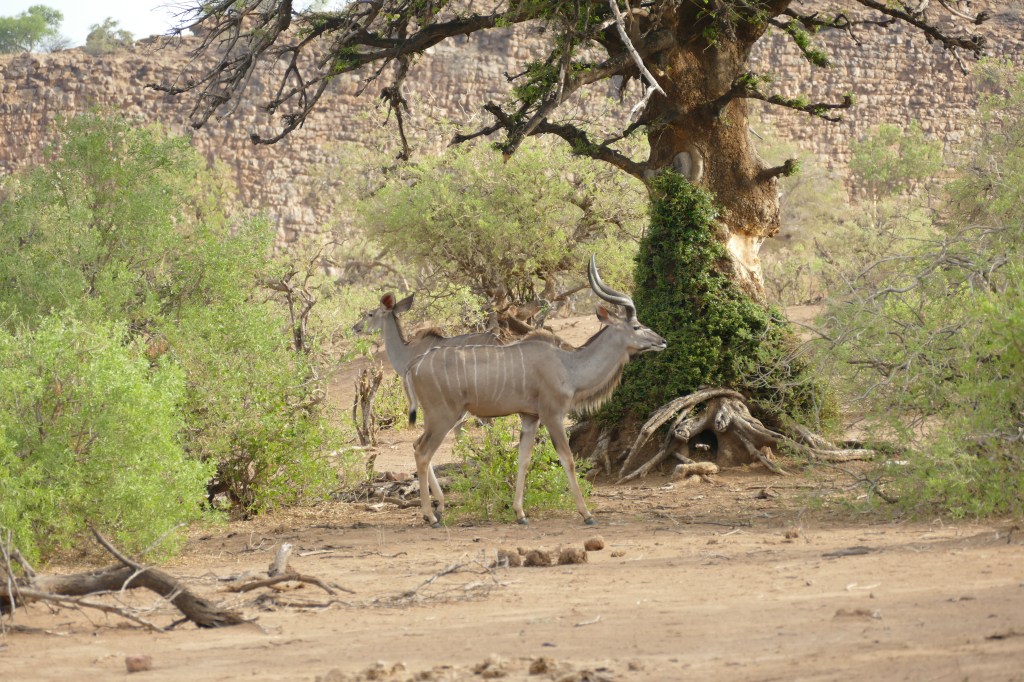
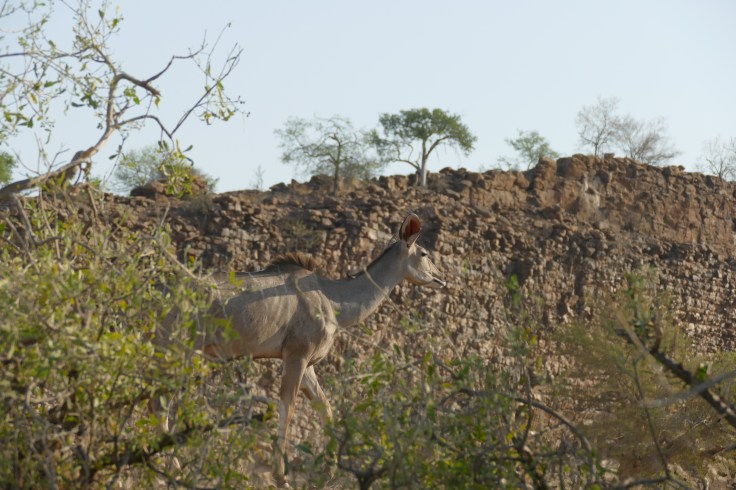
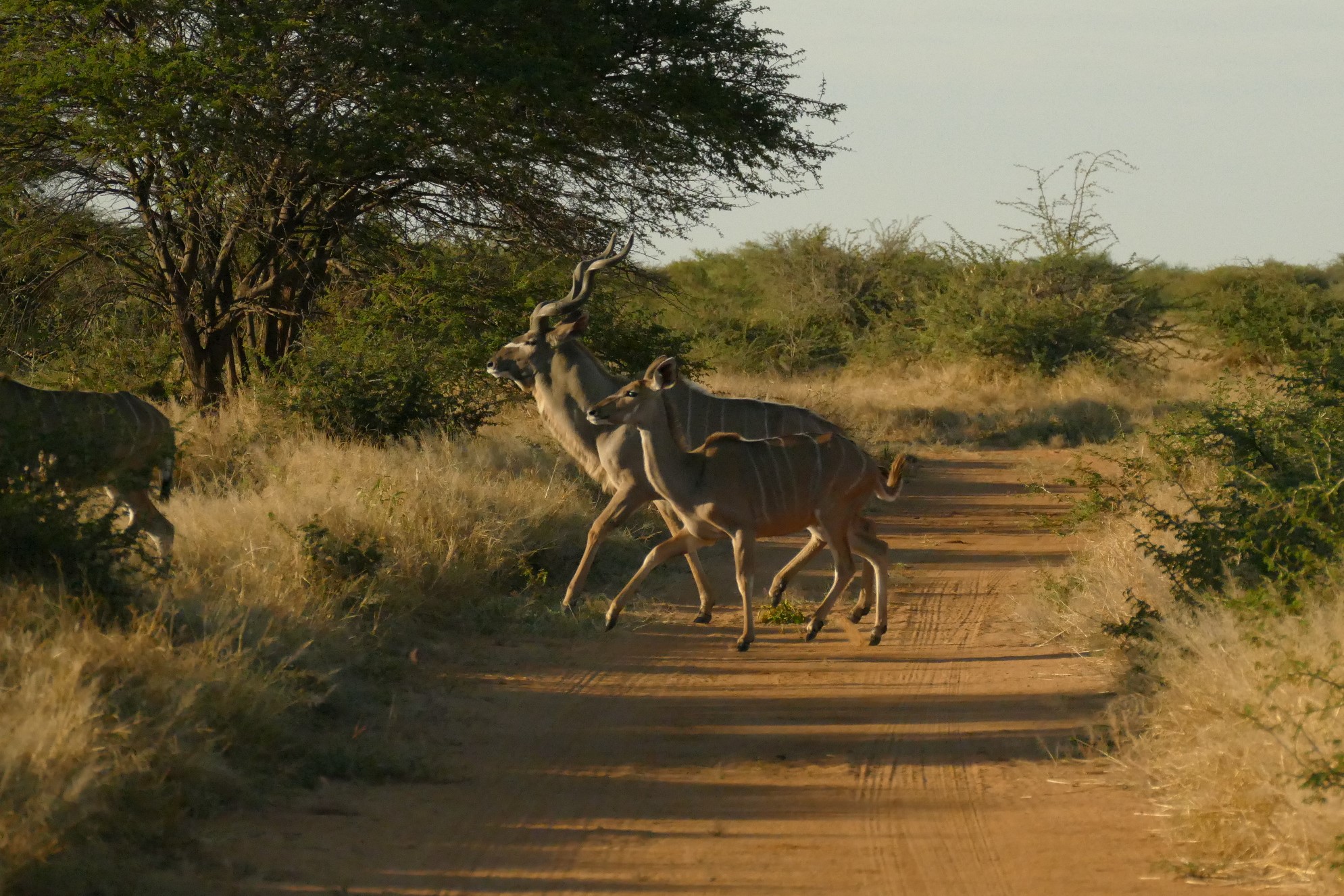
Kudus are highly nervous, shy, and alert and notoriously hard to approach. They spend nearly all their time hidden in thick bush to which they are perfectly adapted. They might browse in opener areas as well, but always in near distance to dense areas. When they detect danger – often using their large, radar-like ears – they freeze, relying on their camouflage rather than to run away as this would make noise. If camouflage fails, they move away quietly or take flight in a distinctive, rocking-horse running motion and accompanied by hoarse bark-like alarms calls. While running, males lay back their horns to avoid overhead obstructions. In case of barriers, they jump far and high (up to 3 metres are no problem), and do this very elegant.
| Seeing a kudu in the bush, staring into one particular direction, ears facing forward, and maybe alarm calling is usually a good indication for predators around. This could be Lion, Leopard, African Wild Dog, or Hyena as their main predators. |
Like other antelopes, kudus are often accompanied by little birds: oxpeckers. Like giraffe, impala, buffalo, and others, they also profit from those helpers. Oxpeckers cling on the fur and remove ticks and other parasites. This is called a mutual relationship: the birds have food whereas the antelope gets its fur cleaned. In addition to this beaty treatment, oxpeckers warn in case of predators, such as lions, leopards and hyeanas.
| It is always worth to listen for the oxpeckers call as this often indicates the presence of antelopes or interesting animals, such as giraffe, kudu, impala, rhino, and buffalo. |
Socialising
Kudus are semi-gregarious, and – especially the females – associate in small family groups that consist of around 12 members and without any obvious hierarchical rank. In general can be seen in three group forms: Females and their young, male bachelor herds or solitary males.
Females and their young live in herds consisting of up to 6 individuals (about 1-3 adults and their offspring). It can happen that two groups of females will join together to form a larger herd, but this would only be temporary. Males live usually singly (outside breeding season) or in bachelor groups, but more commonly, they are solitary and widely dispersed. Mixed groups only occur during the mating season, when males will join a group of females and calves.
Independent of the group structure, kudus practice social grooming.
Kudus are not territorial and dominance between males is usually quickly and peacefully, determined by a lateral display in which one stand sideways in front of the other and makes himself look as large as possible.
Communication
Scent | Vocalisation | Visual
Kudus are equipped with excellent vision and hearing and communicate mostly through sight, scent, and sound.
They can track each other over long distances by following scent trails.
Body signals, such as flashing the white undersides of the tails, are used to indicate the movements and presence of predators. Especially males other body signs are used, such as lateral display (posing sidewards towards an opponent with head erected, showing off its size) or horning. As in humans, this is so called dominance behaviour and occurs mainly during breeding season. Serious fights are generally avoided.
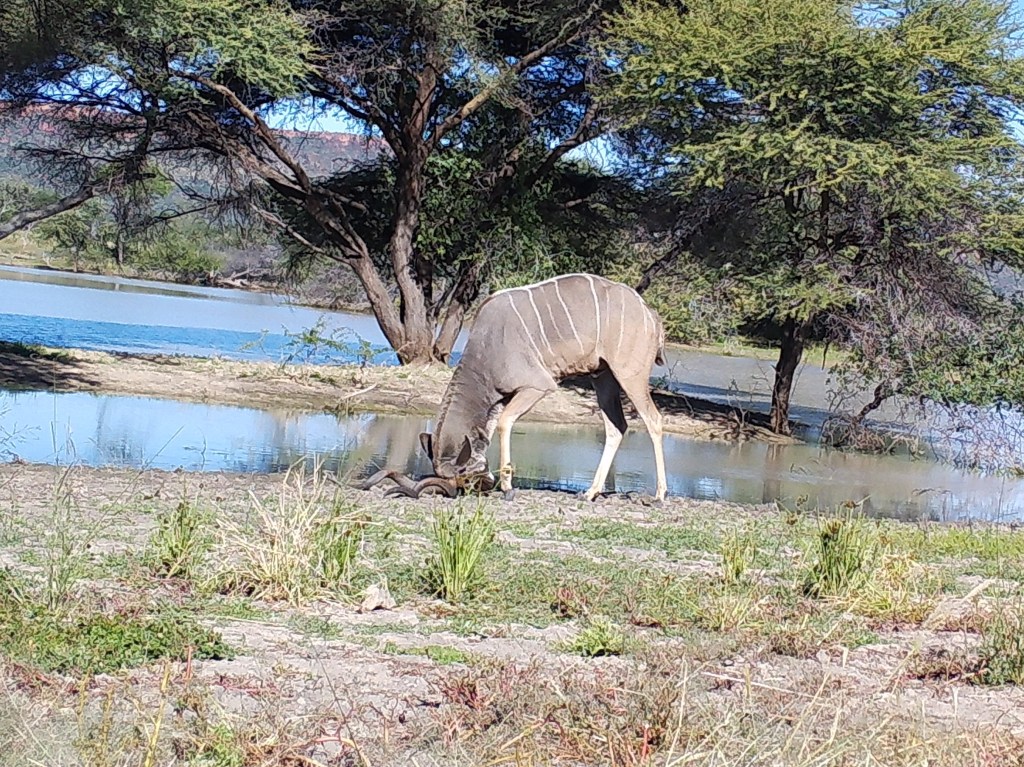
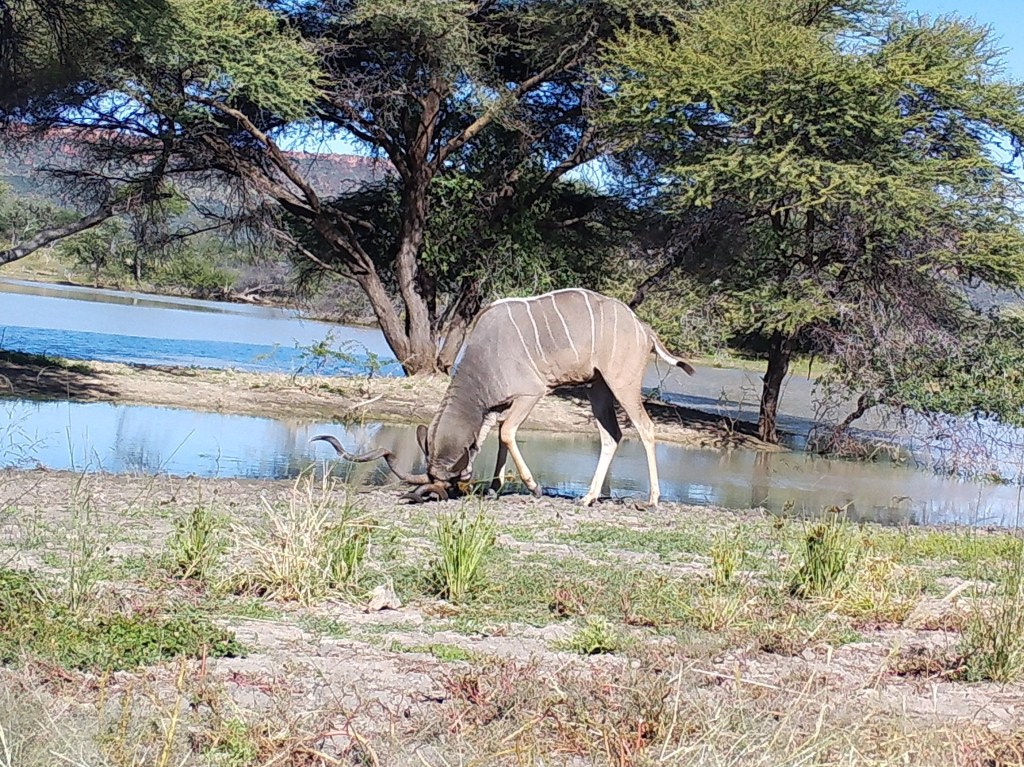
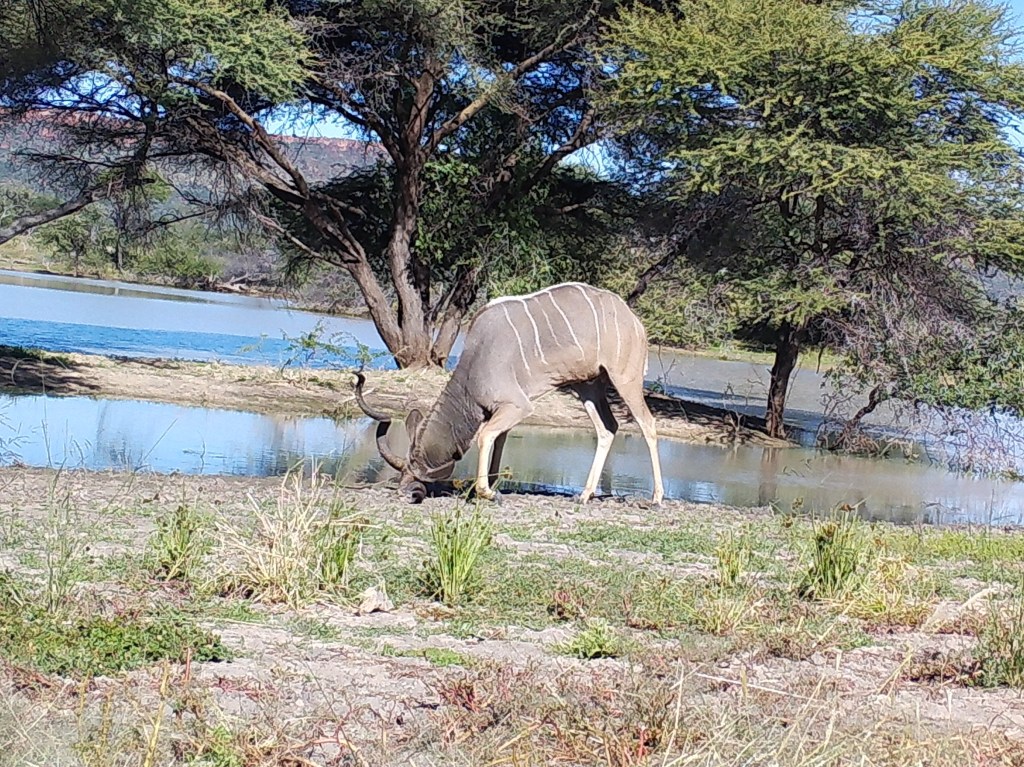
The most communication happens between members of the same social group and when meeting different clans, kudus usually ignore each another even when they are together.
Kudus are not the most vocal species but they warn each other with bark-like alarms call. Males tend to be a bit more vocal and use low grunts, gasps, clicks and humming.
Reproduction & Lifecycle
Gestation: 9 months
No of young: 1
Weaning: 6 months
Sexual maturity: 2 years (♂) / 3 years (♀)
Lifespan: 10-20 years
Kudus breed at the end of the rainy season which is different depending on the area we live in. During the breeding season, bothsexes associate. A male takes over a female group and starts “herding” and protecting them.
The males are rarely physically aggressive to each other to avoid being hurt, and they usually just show off by posing sidewards, to appear bigger and impress the other one. This is called lateral display. Occasionally, they may spar, especially during the courtship season, by shoving one another with their horns. Unfortunately, the horns can occasionally become interlocked during these contests and, if unable to free themselves, both may die.
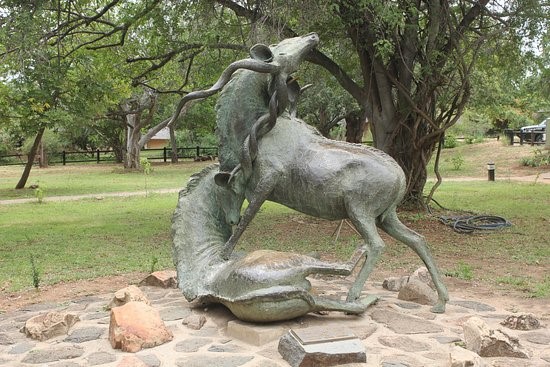
Skukuza KNP; Source: Tripadvisor
Urine-testing, dominance displays, cheek-on-rump rubbing, mutual grooming, and vocalisations such as whining, clucking or grunting are part of the courtship behaviour. After a successful mating, it takes approximately 9 months until 1 (occasionally 2) calf is born.
If nature allows, birth is given when the grass is tall. This provides protection from predators and enough food to raise the young ones. The calves stay hidden for around two weeks before joining the herd.
For the following 4 – 5 weeks the calves roam with the herd during the day and at the age of 6 months, they are weaned and fairly independent. This is also the time when the young males start growing their horns.
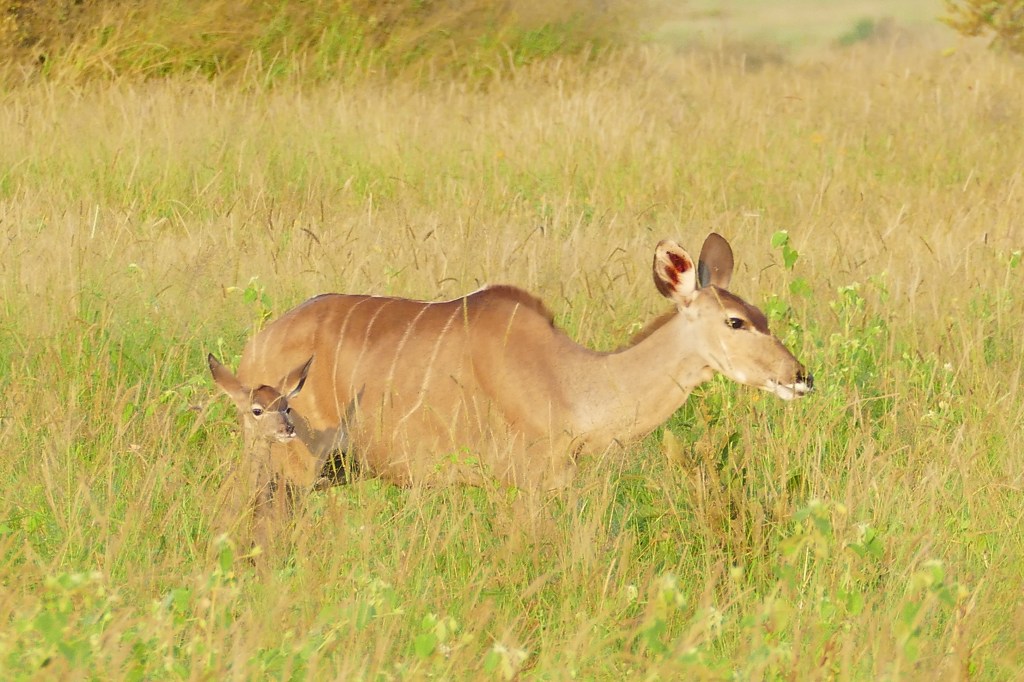
Females reach sexual maturity at the age of 3 years, but those young cows remain with their mothers’ unit. Males reach sexual maturity at 2 years of age and remain in their mother´s herd until they are 1 to 2 years old. They then leave and form bachelor groups that usually consist of 2 – 10 individuals. Those groups provide protection for the still unexperienced males until they are old enough to roam alone. Bachelor herds do not overlap but the range of one bachelor herd may overlap those of two or three female herds.
Diet
Herbivorous (Browser)
Mainly browsers, feeding on leaves, pods, flowers, herbs, fruits and tubers. In winter or dry season, wild watermelons and other fruits are added to their diet (for the liquid they provide). Kudus also practise osteophagia (chewing bones) and geophagia (eating earth/soil). This helps to get trace elements, such as calcium and phosphorus (from bones) or salts (from soil) that they lack in their diet during these times.
Did you know?
The common name kudu is derived from “koodoo“, the indigenous Khoikhoi language of Southern Africa. The scientific name is derived from Greek: Tragos (Greek) denotes a he-goat and ela-phos (Greek) a deer. Strepho (Greek) means “twist”, and strephis is “twisting”. Keras (Greek) refers to the horn of the animal.
In the language of the Zulu people, the kudu is called by the onomatopoeic name of Umgakla. Now, this name is formed by the sound that the clashing of the horns of two kudus locked in combat makes: ‘gakla, gakla,’ as the two great animals clash horns during the mating season.
The horns of a mature bull kudu have two and a half twists, and, if straightened, would reach an average length of 120cm. However, they may occasionally have three full twists and the record length is a whopping 187.64cm. The horns do not begin to grow until the bull reaches 6–12 months, twisting once at around two-years-of-age and not reaching the full two-and-a-half twists until the age of six. They have long served different traditional communities, as both embellishment and musical instrument, the latter including the shofar, a Jewish ritual horn blown at Rosh Hashanah.
The traditional sport of Kudu dung-spitting (Bokdrol Spoeg in Afrikaans) is practiced in the South African Afrikaner community. The winner is the contestant who is able to spit one of the antelope’s small, hard dung pellets the furthest – with the distance measured to where it comes to rest. An annual world championship was launched in 1994, with contests held at community events, game festivals and tourism shows. The world record stands at 15.56m, set in 2006 by Shaun van Rensburg Addo.
Kudus are called “ghosts of the bush” due to their ability to disappear so quick.
When running, males put their head back in the neck to not get stuck in the thicket.
Traditionally, African tribes use kudu horns – hollowed out as a wind instrument, to communicate. Locally the Zulu and Matabele tribes used the horns ceremonially and in wartime.
Top speed: 70 km/h.
Folktales & Traditional Stories

 Sininho´s World
You must be logged in to post a comment.