Giraffe
Giraffa camelopardalis
Description, Habitat & Distribution
Lifestyle, Behaviour & Social life
Communication
Diet
Reproduction & Lifestyle
Did you know?
Folktales & Traditional Stories
Description
Foot structure: Unguligrade (Even-toed ungulate)
Height: ♂ 5 m / ♀ 4.5 m
Weight: ♂ 800-1400 kg / ♀ 550-1180 kg
With up to 5 metres, I am the tallest terrestrial mammal on Earth. Although we giraffes have the same number of vertebrates as humans, our neck alone can grow as long as a human´s body size (up to 1.80 metres). We also have long legs and our body is covered with a beautiful leopard-like pattern consisting of large, irregularly-shaded patches that are separated by networks of light-coloured, brown bands.
And – sorry ladies – we have those large, beautiful eyes and stunning eye-lashes.

We both, males and females, have horns, so called ossicones, that are made of bone and fused to the skull. Ossicones are covered in brown hair and end in dark brown to black tufts.
Sexual dimorphism
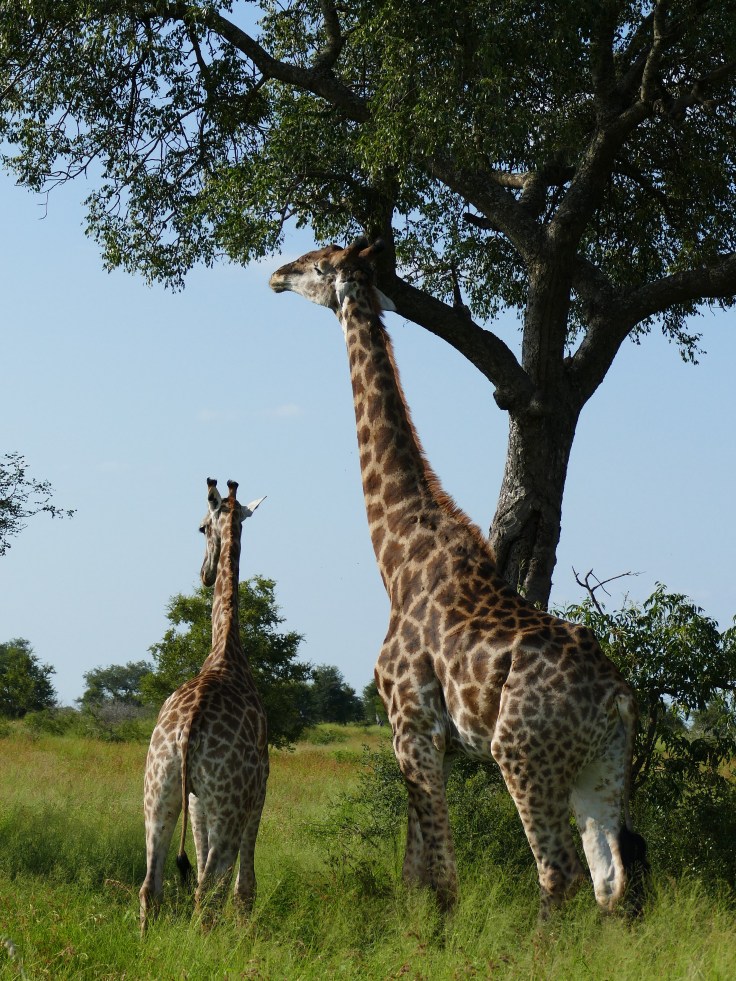
The horns of us females are thinner and covered with dense hair at the top, while males’ horns are broader and heavier built with the top going bold from frequent necking and fighting with other males. We females are slightly shorter and have a shorter, lighter necks than our men.
In us females, the belly slopes up towards the groins whereas in the males the belly slopes up towards the chest and the penile bump is visible at the belly.
Habitat
Savanna woodland
Distribution
South of the Sahara to northern Namibia, northern Botswana and Mpumalanga province.
Lifestyle, Behaviour & Social Life
Gregarious
Non-territorial
Diurnal
We are a social, group-living animal, with a variable and constantly changing group composition.
We females and our young ones form small groups and so do males or bulls (so-called bachelor herds), but also mixed “herds” are possible. Dominant bulls are often seen travelling solitary.
If you see us in a stationary group, this is known a tower or kaleidoscope. When we are on the move, we are called a journey.
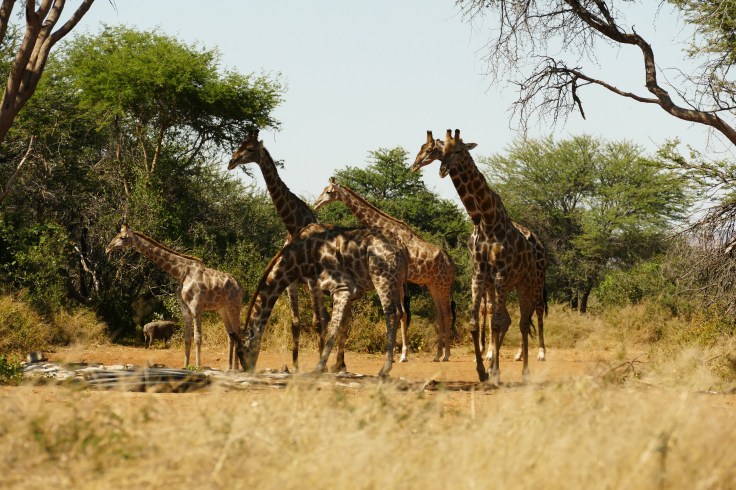
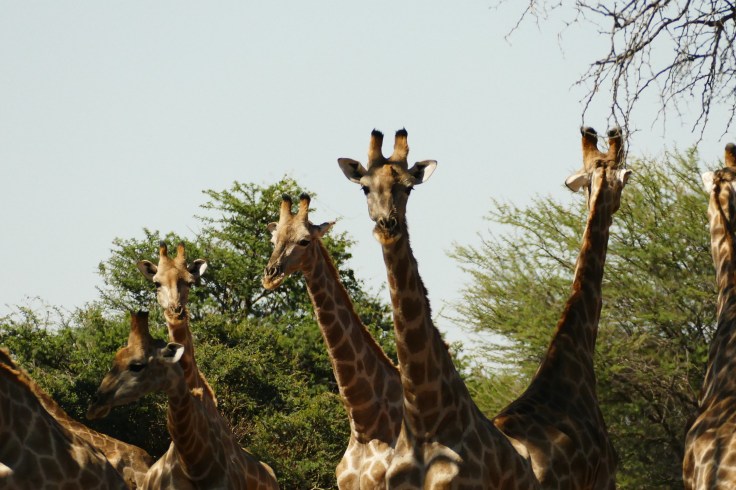
As you can imagine, we have quite a good view from up there. With our excellent hearing and eyesight, we identify potential predators from far away and will stalk everything that seems dangerous or unknown. With this, we make sure to keep an eye on any potential danger and make it clear to any predator that we have seen it, so an attack is pointless.
We are peaceful animals and will rather run away in case of attacks, but if it comes hard to hard, we will also fight. Our legs are powerful, equipped with hard, sharp hooves. We will not hesitate to kick anyone that comes too close to us. Our kicks are dangerous, and we have killed lions with it, so we must not be underestimated or seen helpless.
| This is also a good indication of potential predators: if you ever see a tower of giraffes looking in the same direction, it might well be that some lions are around. |
Same with humans. When we see you, we usually stop eating (or whatever we do in that moment) and look at you to figure out the situation and we often restart chewing, but not loosing eye-contact. If we feel safe, we continue with our task. If we feel uncomfortable with the situation, we slowly walk away but if we feel unsafe, we run off.
We do not like to run as there is the risk to stumble and fall which would probably be our death sentence. But if we have to, we can run up to 60 km/h. And if you ever have seen us, even with that speed it seems as if we run in slow-motion.
| Interesting enough: If you ever meet giraffes on foot and simply walk past them (in best case without looking at them), instead of stopping, they usually just watch you but do not move away. |
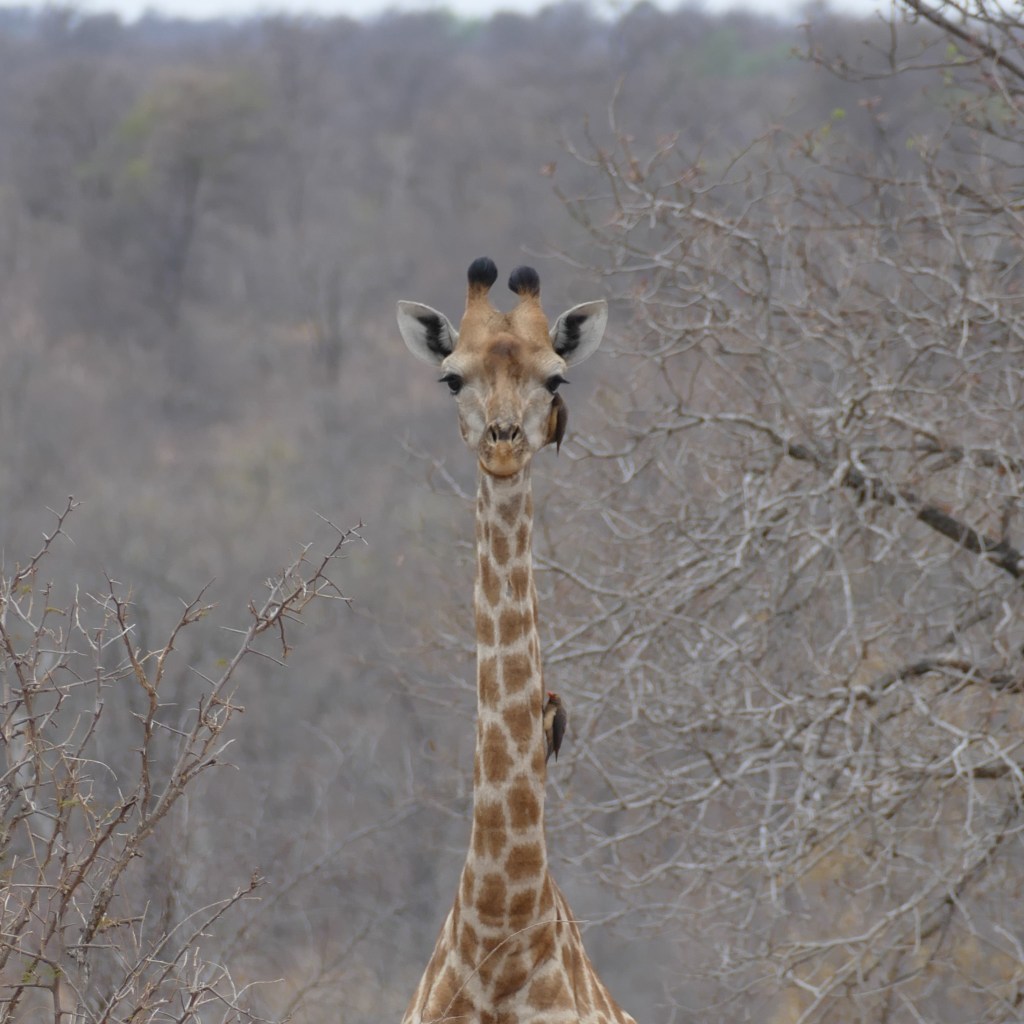
We not only socialise with our own species but are often seen together with oxpeckers. Better to say, the oxpeckers are seen on us. We live in a mutual relationship, a so-called mutualism and both profit from each other. But how? The bird has an adapted foot structure, allowing them to perch on our body where they feed on ticks and other parasites (therefore also their name “tickbird”). We on the other hand get those nasty parasites removed. Unfortunately, the oxpeckers sometimes finds pleasure in drinking blood and gets into the habit of opening old wounds which can cause us permanently inflamed lesions.
To get rid of nerve-recking parasites on the belly or other locations that are hard to reach, we also use bushes or small trees (preferably thorny acacia trees) and walk back and forth over them a couple of times.
| When we first experienced this behaviour, we did not know what it means. In other species we would have thought it is a territorial or dominance behaviour, but as the giraffe is non-territorial, this did not apply. |
We giraffes are diurnal animals and constantly on the move to forage. We are browsers with a feeding average of approx. one minute per tree (but don´t be confused if we stay longer). With our exceptional long neck, we are made to feed on the tree canopies and you often find a “browsing line” on the trees we have been. We only sleep about four hours and this usually in an upright position. It is simply too dangerous to lay down. It would take us too long to get up in case of danger and we could end up as easy meal, but from time to time you can find us on the ground, taking a nap for a couple of minutes.
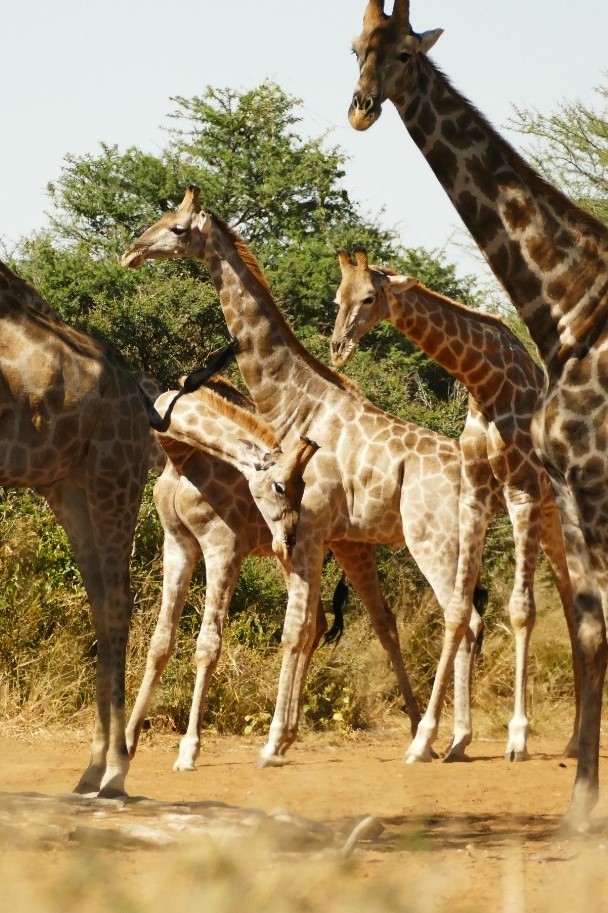
Sometimes you see two of us swinging the neck towards the neck or chest of each other. This behaviour is called “necking” and can be either courtship behaviour between males and females or dominance behaviour between males (often seen in our teenager boys when they start practising).
In case of the second, “fights” can go for hours and rarely lead to the knock-down of the other one.
Communication
We are usually not so vocal, and most sounds would be related to stress but our repertoire includes bleats, squeals, whistles, bellows, snorts, and hissing.
Reproduction & Lifecycle
Gestation: 15 months
No of young: 1
Weaning: 12-17 months
Sexual maturity: 3-4 years
Lifespan: 25 years
Courtship starts with a urine test. A bull approaches the cow and smells the urine with the head stretched far up in the air and the lips curled and everted. It looks a bit awkward and contrary to popular belief it is not called “funny face” but “flehmen” and is a very typical behaviour in the animal kingdom. The bull will also rub his head near the rump of us females and rest it on our back, lick the tail and lift his foreleg.
If we are receptive, we will circle the male, lift our tail and place ourselves into mating position.
After a gestation period of 15 months, we give birth to one baby which is already about 2 metres tall and weighs 50 kg. Our new-born can stand up within an hour and are able to run within a day. This is important but still about 50 per cent of our youngs will not make it through the first months.
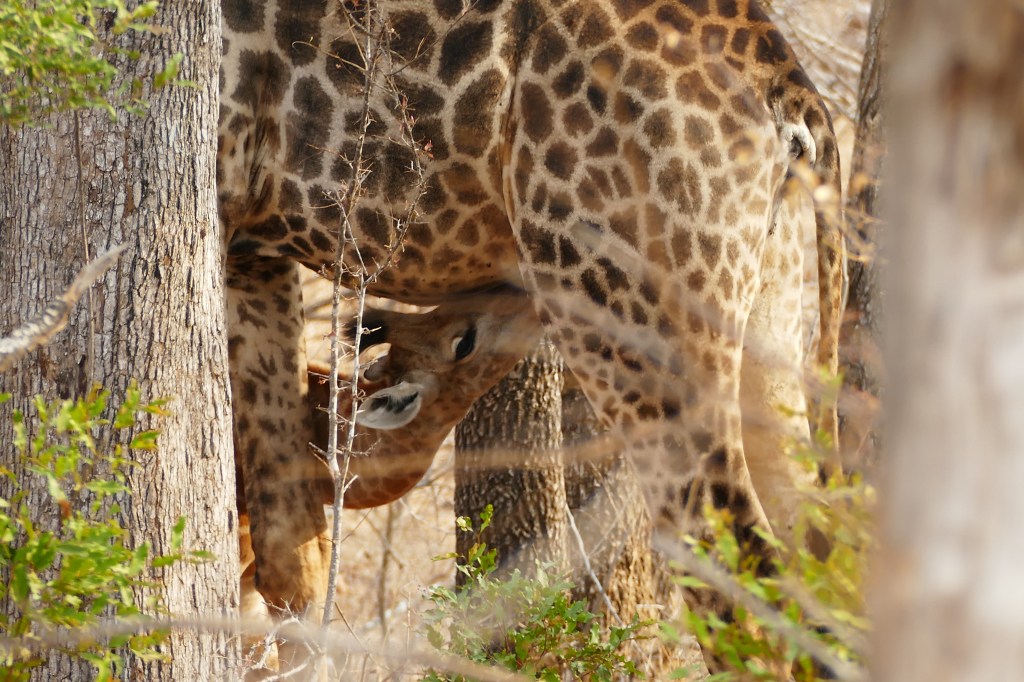
For the coming time, our offspring follows us because they are still reliant on our milk. When they grow older, they form own temporary herds with same-aged giraffes but stay closely to us mothers. We wean them at an age of 12 to 17 months and sexual maturity is reached with 3-4 years when they start their own family.
Diet
Herbivorous (Browser)
We are explicitly browsers and forage for around 12 hours a day. Due to our height we feed on leaves above the level of other browsers and therefore do not compete with them. Watch out for a “browsing line” or even hour-glass shaped acacia trees that can be indicators that we have been (or still are) in the area.
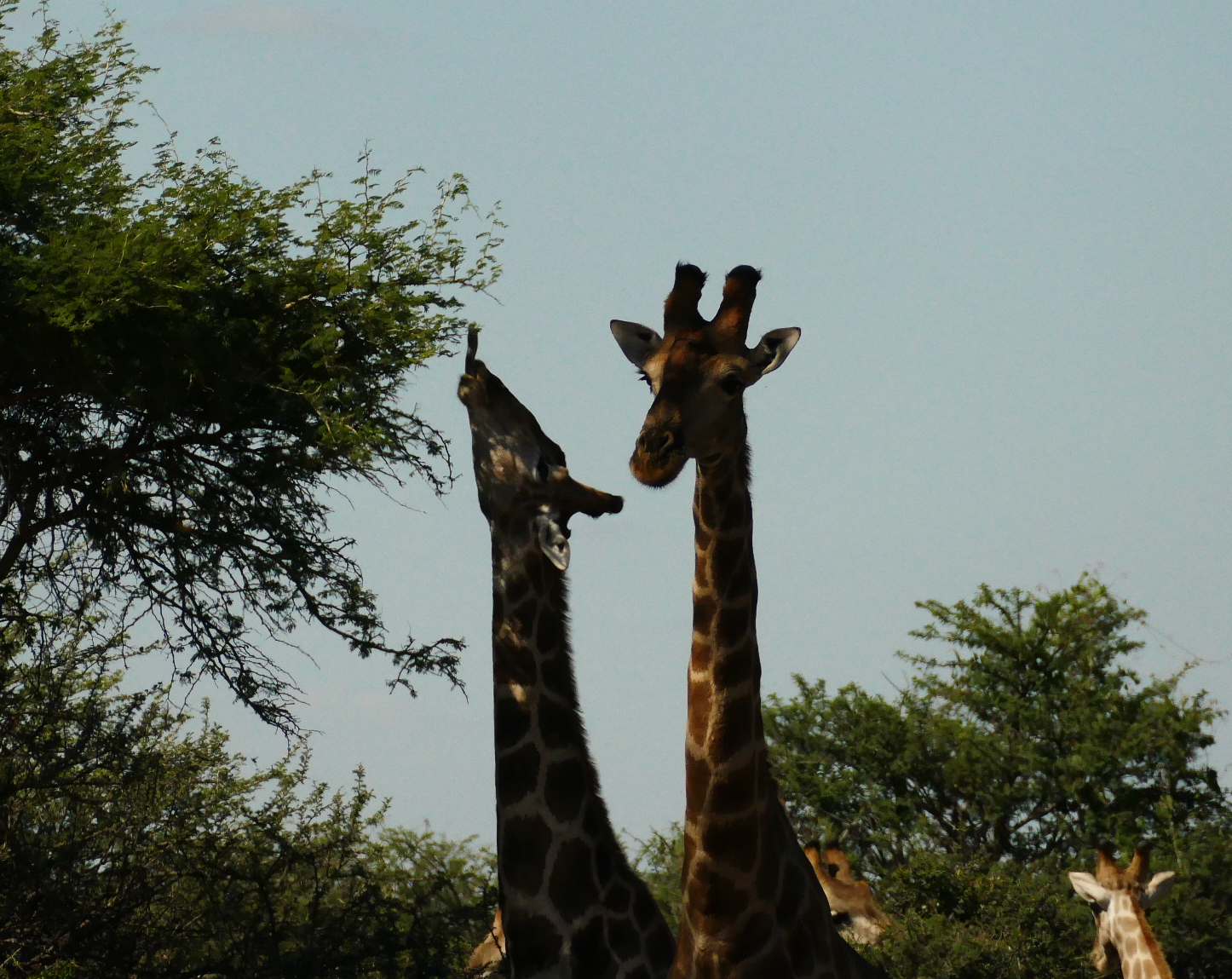
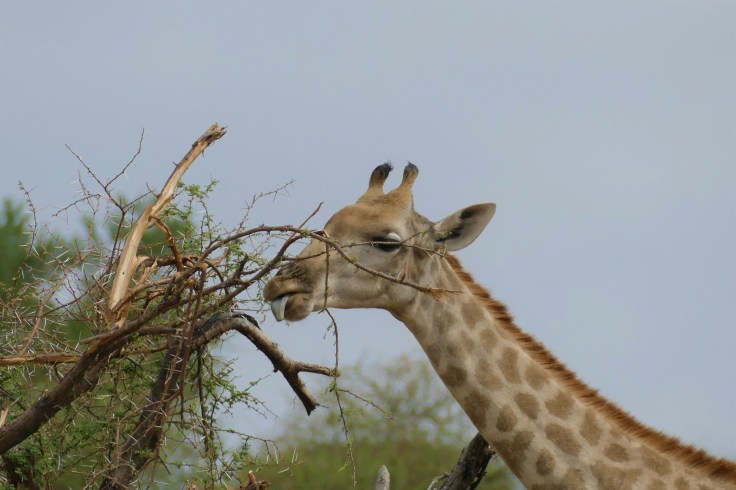
We love acacia trees and if you have ever seen or even touched one, you know that they are quite thorny, but we developed quite a technique to avoid getting hurt: we either wrap our 45 cm long tongue around the branch and rip the leaves off or – in case of hooked thorns – we use our well-adapted pointed lips to simply pick the leaves off the branch. In addition, a horny skin on the roof of our mouth, and horny projections on the inner lips and the tongue provides some extra protection.
Did I say we are explicitly browsers? Yes, we are but from time to time you might see us with a bone sticking out our mouth. Especially during winter or dry season, when trace elements like calcium and phosphorus lack in our vegetarian diet, we chew bones to retrieve those elements. This is called osteophagy.
Being such a tall animal has definitely advantages. But not when it comes to drinking. To reach water, we must spread our front legs and sometimes even bend them to bring the head down. We are very vulnerable in this position and therefore observe our environment carefully beforehand. To avoid excessive blood flow to the brain when drinking, we have a clever and complex pressure-regulating system in the upper neck, called rete miribale.
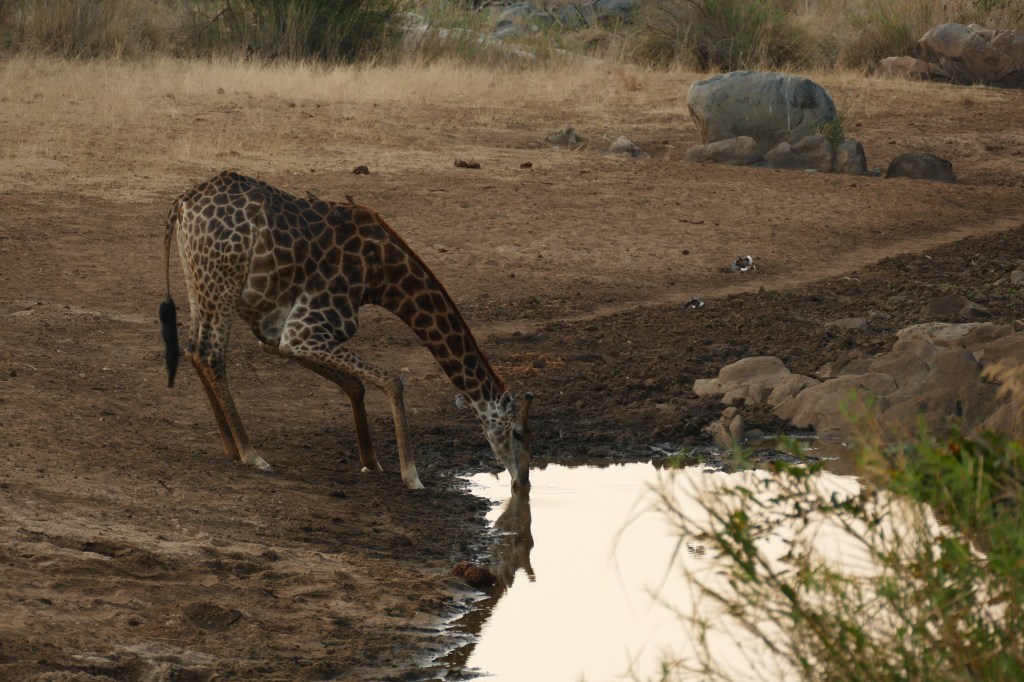
Water is taken every few days when available, but we can go without for some weeks if we have to.
Did you know?
The name giraffe comes from the Arabic word “xirapha” and means “one who walks swiftly”.
The scientific name “camelopardalis” translate “the one who walks like a camel and looks like a leopard”.
Just like human fingerprints, no two giraffes have the same coat pattern.
The pattern of the fur helps for temperature control and regulation.
The heart of a giraffe beats up to 170 times per minute (in comparison to a humans normal resting heart rate of 60 to 100 per minute). This is necessary to maintain the blood flow to the brain against the earth gravity.
The giraffe is the tallest land mammal on earth.
The giraffe´s tongue is about 45 cm long and contains melanin, therefore the purple colour. It is said that it protects of sunburn during the up to 12 hour long feeding period.
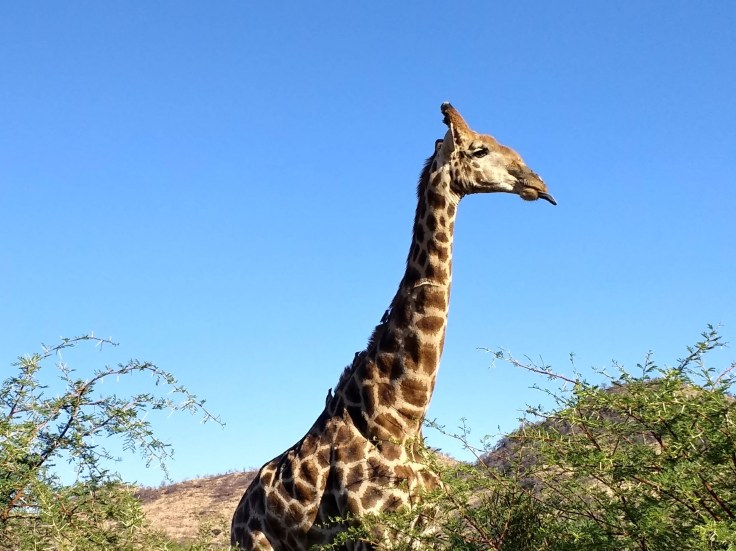
Just like humans, giraffes have seven neck vertebrae. However, each one can be over 25 centimetres in length.
Top speed: 81 km/h.
Folktales & Traditional Stories
Why giraffe and oxpecker are good friends

 Sininho´s World
You must be logged in to post a comment.