Blue Wildebeest
Connochaetes taurinus
Description, Habitat & Distribution
Lifestyle, Behaviour & Social life
Communication
Diet
Reproduction & Lifestyle
Did you know?
Folktales & Traditional Stories
Description
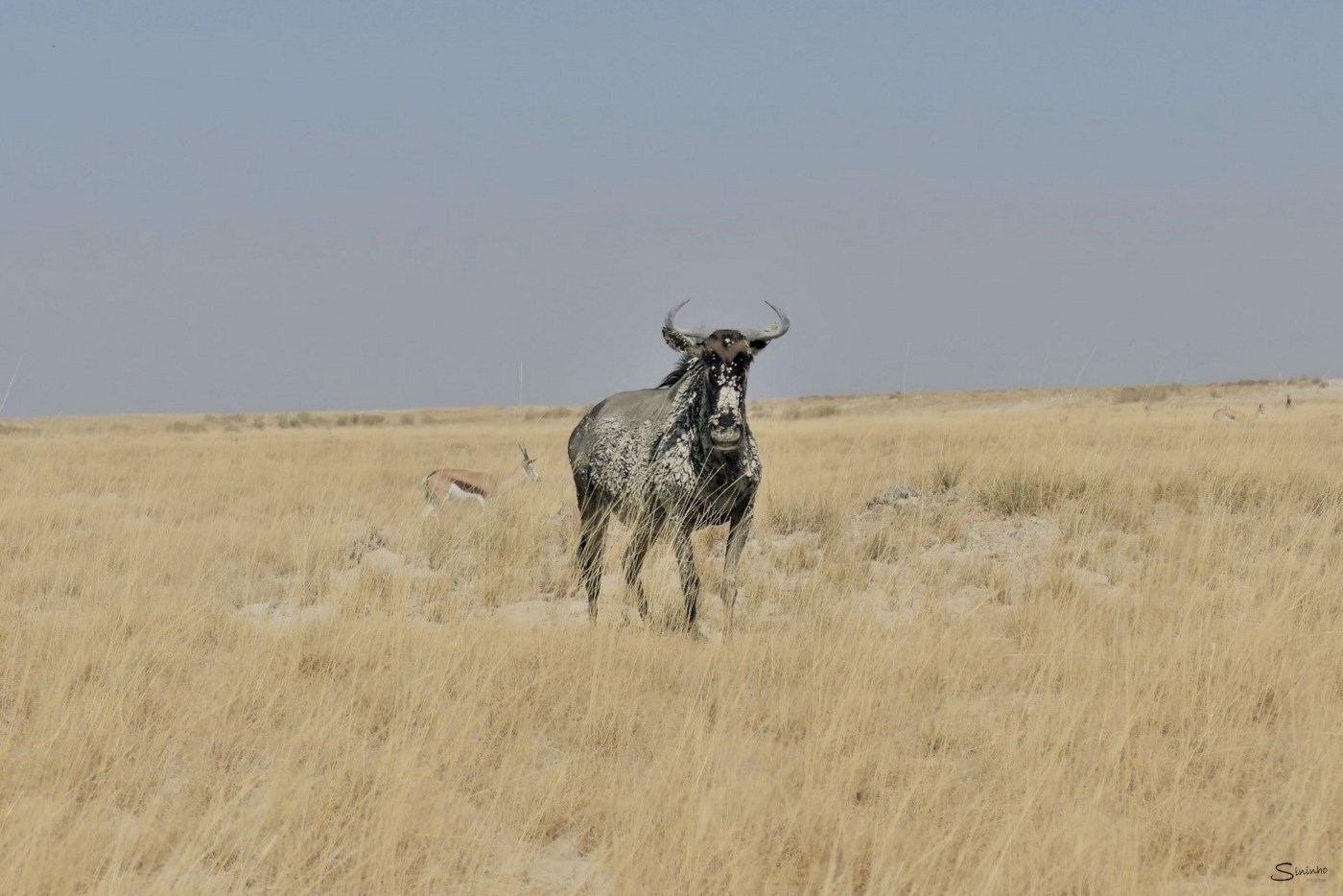
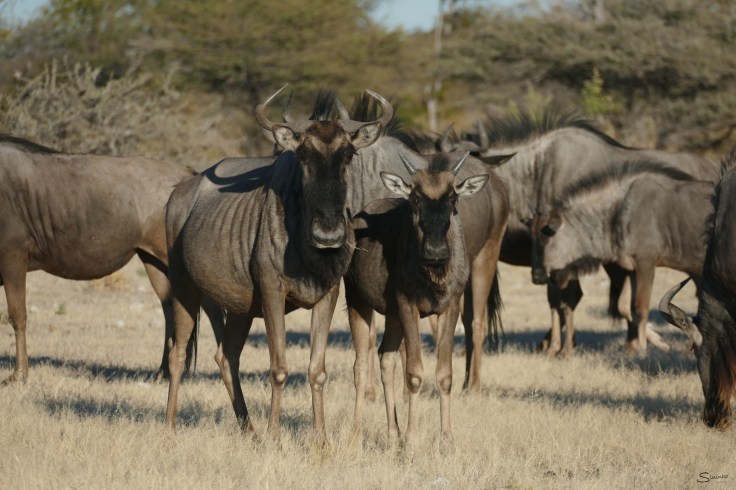
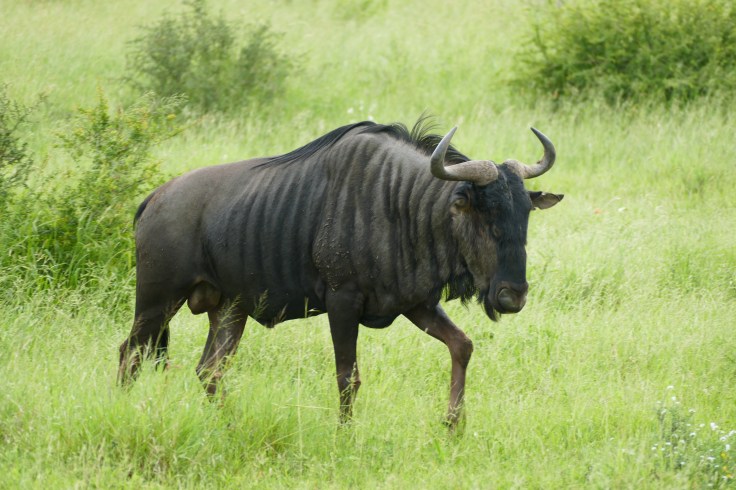
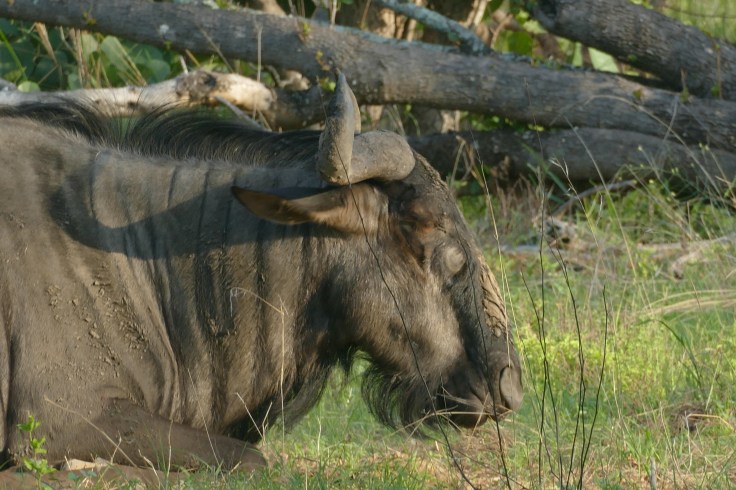
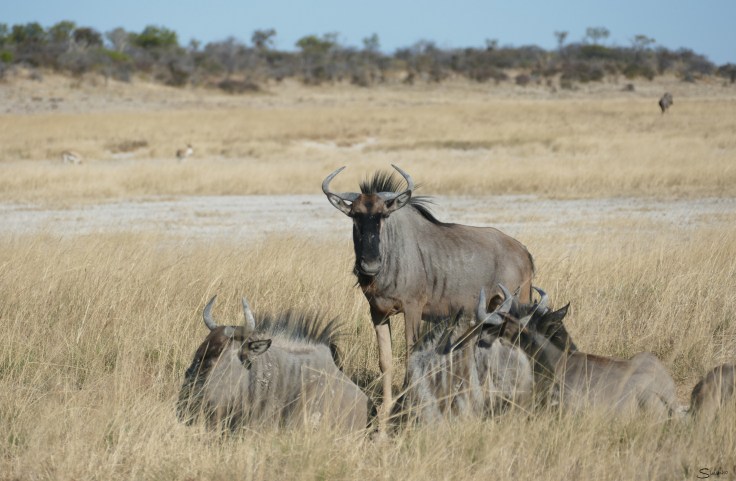
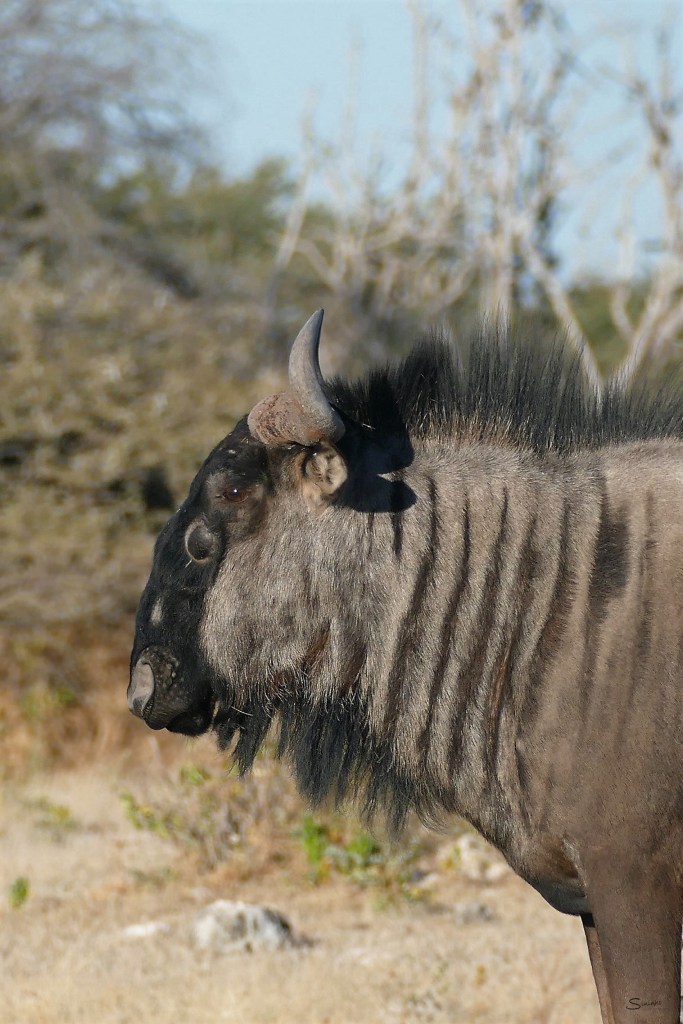
Blue wildebeests have a stout body and its dark silver-grey coloration is disrupted with dark vertical bands on the shoulders and back.
The body is sloping down towards the back legs, perfectly adapted for long distance runs.
Blue wildebeests have a long black mane, a broad muzzle and a beard of hair hanging from throat and neck.
Both sexes carry unridged horns.
Sexual dimorphism
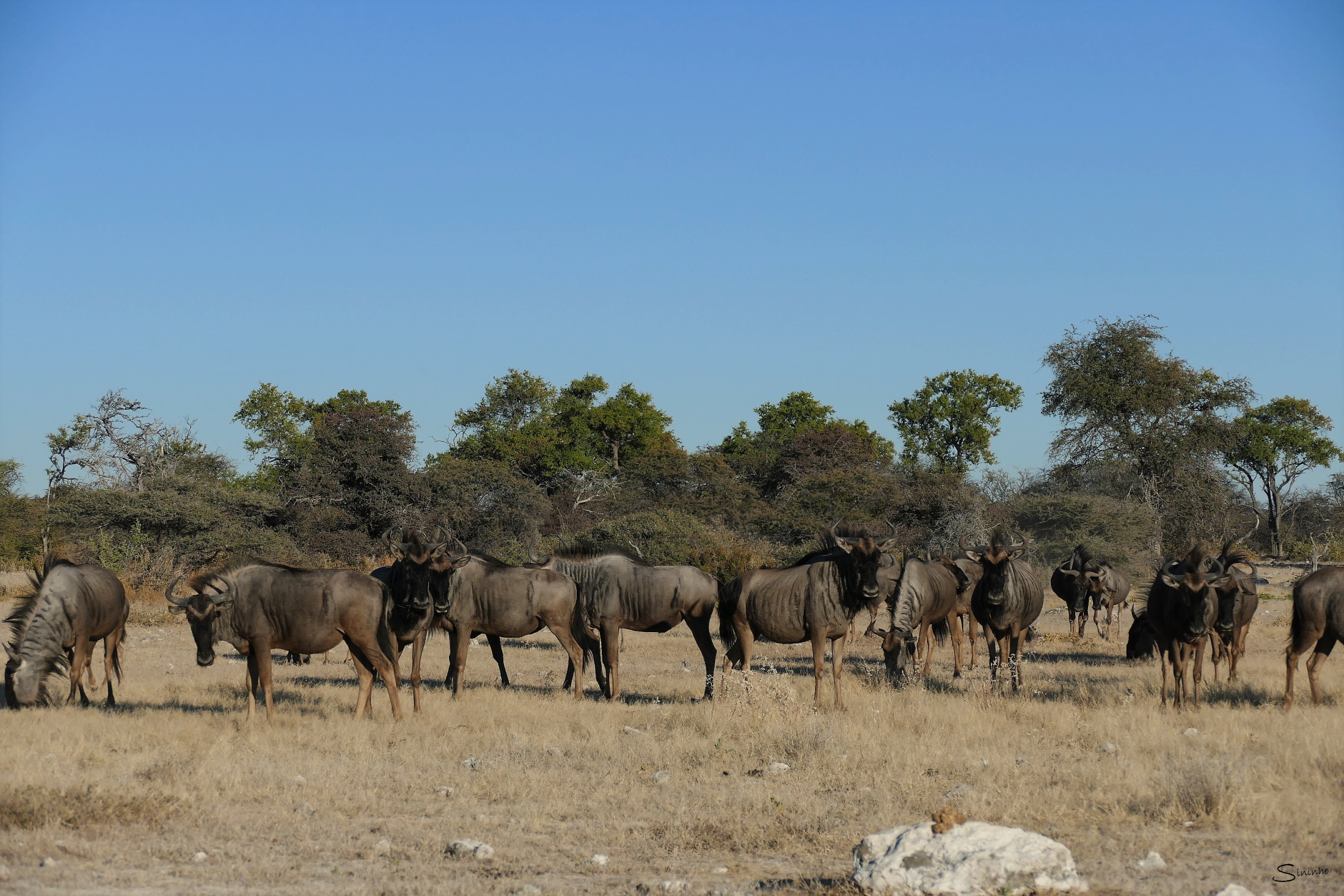
You can hardly see a difference, as both males and females are similar in size and carry both horns. But there is a trick to distinguish the animals: The forehead of the males is usually black, with the females it is rust-coloured and the horns in males are thicker.
Habitat
Blue wildebeest is found in savanna short grass plains and open woodlands.
Distribution
Northern Namibia through Botswana, Zimbabwe, Mozambique to northeast of South Africa.
Lifestyle, Behaviour & Social Life
Gregarious | Territorial | Diurnal
Wildeeest are gregarious animals and occur in group numbering between 10 and few thousands.
The herd composition varies depending on the environmental conditions, such as availability of food and water.
Bachelor groups are formed by non-territorial bulls, female groups with their young occur in the presence of a dominant male.
Solitary dominant males can often be seen. The dominant males will keep their territory all year round even outside the breeding season, when females with their offspring move out of the territory in search of better food and water.
Blue wildebeest are most active in the early morning and late afternoon (and during bright moonlight nights) when they move to and from their grazing area, then during midday when it is very hot and predators are mostly inactive, they will go to drink water. They can be found resting in the shade under trees but are mostly found in open areas where they have a good view on their surrounding.
| Wildebeest are suspicious animals with a good memory. I had once participated the de-collaring of a Blue wildebeest. We had to get to a darting distance of about 40 meters but the group became spooked and it was a game of patience and endurance. When we finally got it, it was a task of only a couple of minutes to get the collar off. The next day I went back to the same area for some game viewing and on my way found the Wildebeest again that we had darted the day before. It saw me coming and immediately became alerted, snorted, and the complete herd ran in a safe distance. The look she gave me was unmistakable: “I know your face. You don´t get me again!” |
Antipredator behaviour
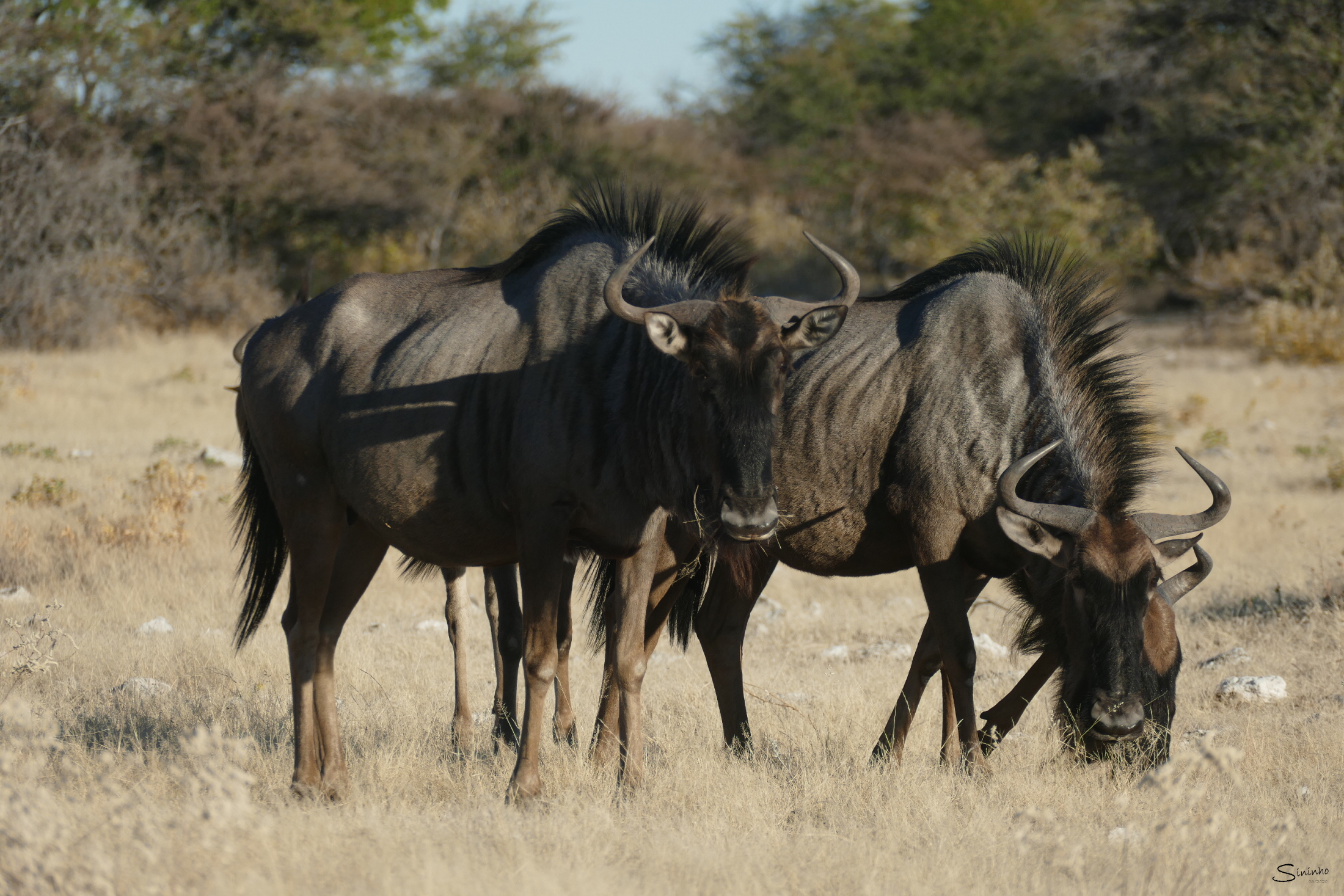
If a potential predator is spotted, wildebeests will usually stand still and watch for a while (if distance allows) and snort to express their worry, but then they flee to safe ground.
| When I “lived” in the Etosha Park, I stayed close to the fence and one day around lunch decided to have a quick look if I see something interesting out there. It is only about 40 meters to the fence but the path is full of stones and grass so it is nearly impossible to walk silently. I did my best to avoid any noise but when I arrived at the firebreak, a group of wildebeest was standing there, staring at me. They had just been on the way to the waterhole of of course they had heard me coming. I felt so bad. Around twenty faces where looking in my direction and as soon as I stepped out I saw their irritation that was expressed by constant “gnouing”. I did not dare to move any more and it took about half an hour before they relaxed and continued their way to the water. |
Interspecies relationships
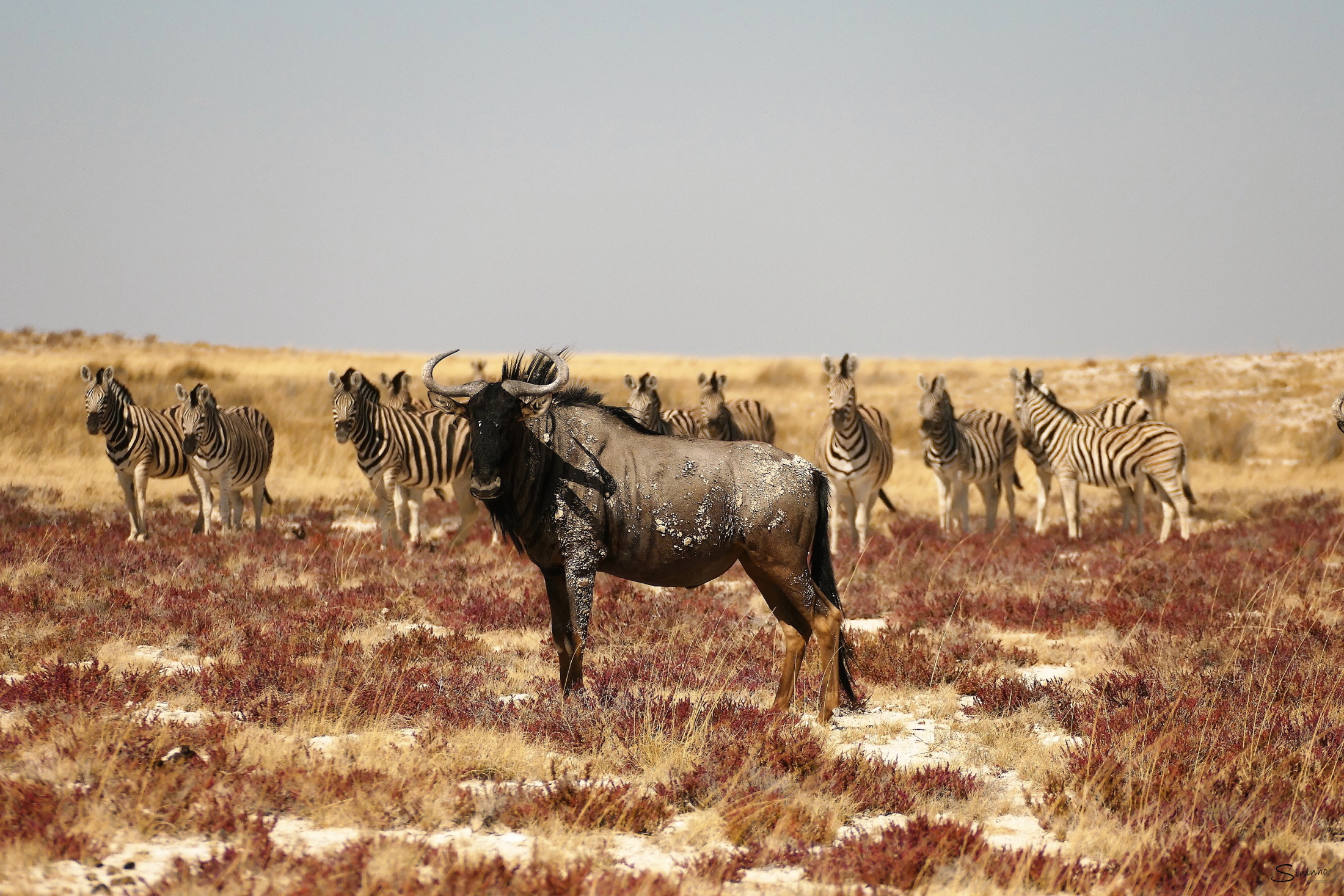
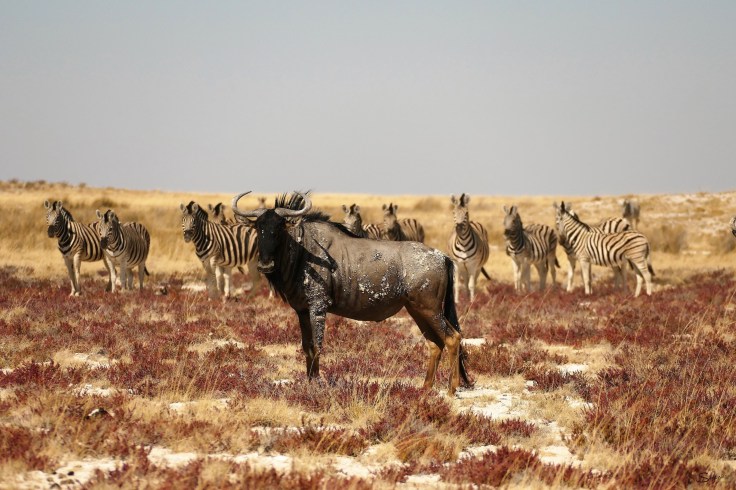
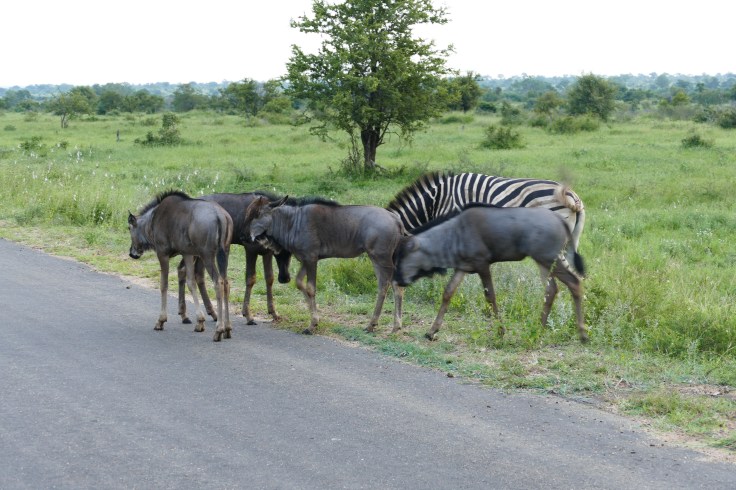
Blue wildebeest can often be seen together with Plains zebra. Both species are grazer but as the zebra prefers long and the wildebeest shorter grass, they do not compete over food. It might be coincedental that they mix but it provides a better protection towards predators as more eyes see more and both species react on the alarm call of the other one.
Communication
Sound (Vocal) | Olfactory (Scent) | Visual
Territorial males or alarmed individual give loud “gnou” sound and a male’s territorial bellow can carry up to 2 km.
Especially mature males of 4-5 years are extremely vocal. They will start chasing each other, while snorting and grunting.
Reproduction & Lifecycle
Breeding and birthing occur aligned with favourable climatic conditions. Rut season usually starts in in March when the animals had the whole rainy season to get into prime physical condition.
During this time, the rut, bulls become extremely vocal and often get so excited that they will froth at the mouth.
To determine the reproductive status of females, their urine is tested by the bulls and once females in oestrus are in their territory, these territorial bulls do not rest or feed but spend their time with herding the females. They will constantly attempt to mount, continue with dominant displays and chase intruding bulls out of their territory.
Females will mate with several males while she moves through different territories during the time that she is in oestrous and births of a single calve per cow occurs after a gestation period of nine months during summer which is often a time with sufficient food and water.
Blue wildebeest have the most precocial calves of all antelopes and they can run within minutes after birth and keep up with the herd after around two days. The birthing happens within a couple of weeks each year and the calves are therefore all the same age.
The calf will leave the mother at the age of around 8 months and form peer groups with other calves.
Diet
Herbivorous (Grazer)
Wildebeests are selective grazers and prefer young grass up to 15 cm.
Did you know?
The horns of the wildebeest serve for thermoregulation, e. g. they hold it in the wind to cool down.
At night, blue wildebeest lie next to each other in lines with space between the individuals to allow movement between them and to ensure there is limited obstruction should they have to flee from a perceived threat.
A group of wildebeest is called a confusion probably due to the noise and confusion that happens when all the animals get together to migrate.
During the mating season, the bulls of Blue Wildebeest become very noisy and keep on bellowing repeatedly in an attempt to attract the females.
Another name for the wildebeest is gnu, related to the sound they produce.
Top speed: 50 km/h.
Folktales & Traditional Stories
The ugly wildebeest (Credo Mutwa)
How the wildebeest saved the animals (Credo Mutwa)

 Sininho´s World
You must be logged in to post a comment.