Black-backed Jackal
Canis mesomelas
Description, Habitat & Distribution
Lifestyle, Behaviour & Social life
Communication
Diet
Reproduction & Lifestyle
Did you know?
Folktales & Traditional Stories
Description
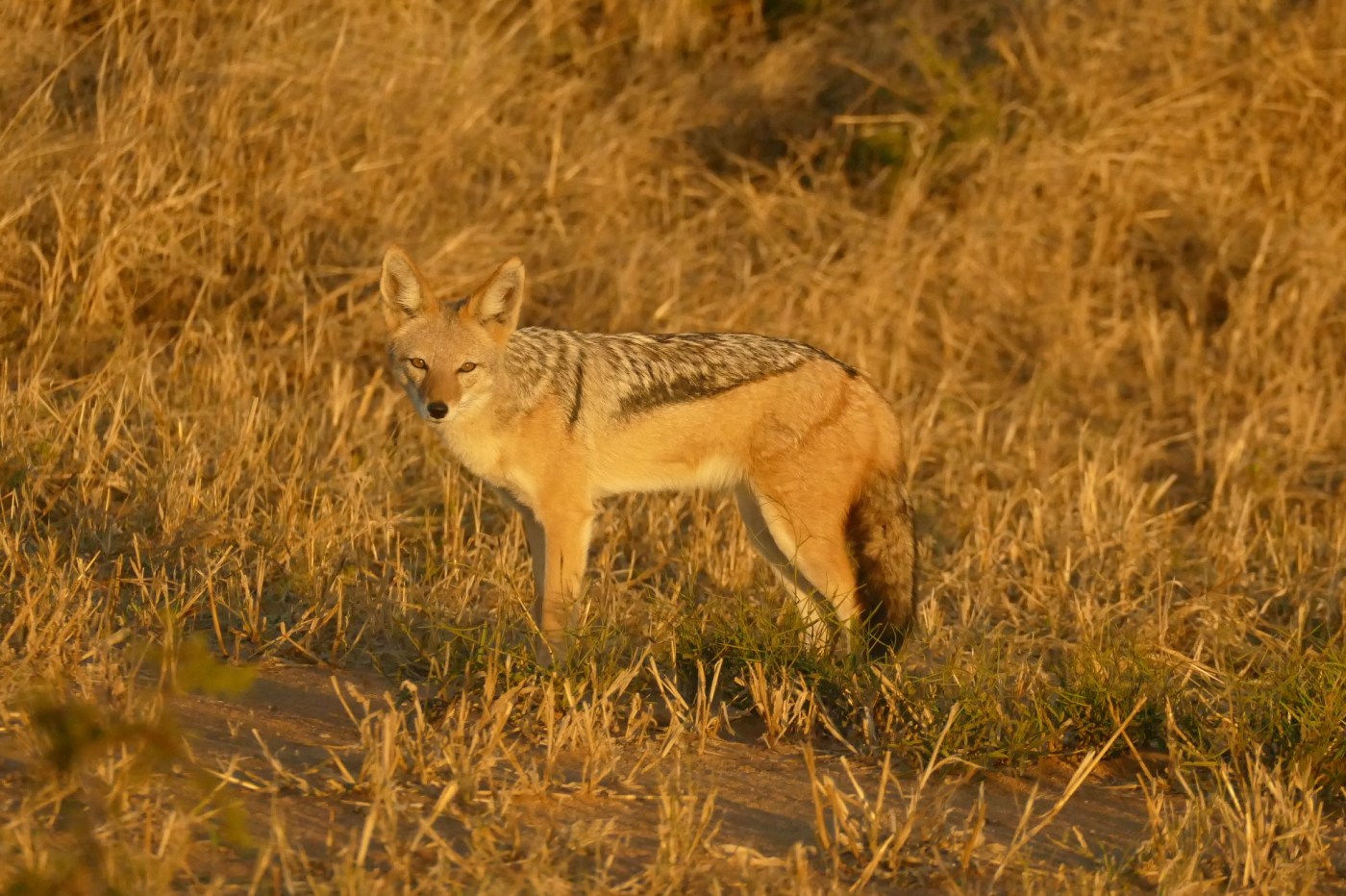
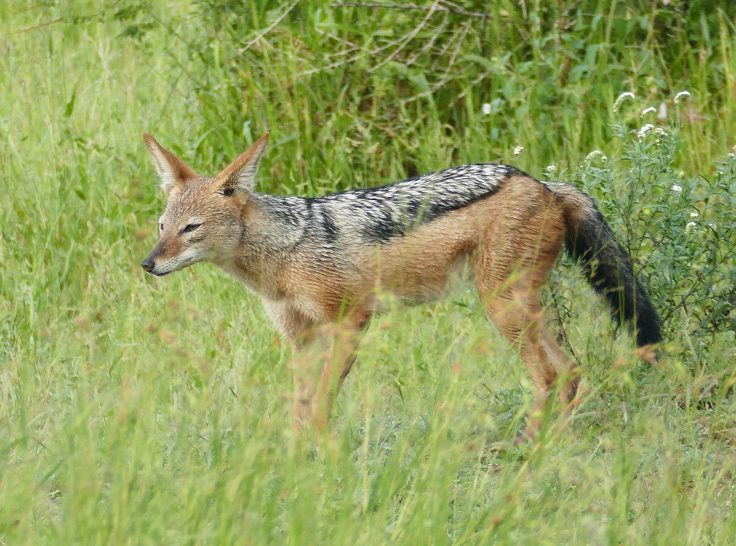
Black-backed jackals have a fox -like appearance with a reddish-tanned to tanned coat, a distinctive dark (black tinged with grey) saddle on the back and a bushy tail that ends with a black tip. The ears are long and pointed.
Sexual dimorphism
Males tend to be slightly bigger and heavier.
Habitat
Wide range of habitats, from arid coastal deserts to savannas, alpine areas or farmland and the show a preference for open areas with little dense vegetation
Distribution
Southern Africa, northern Ethiopia to the Horn of Africa, Tanzania, southwestern Angola and Zimbabwe.
Lifestyle, Behaviour & Social Life
Monogamous pair | Territorial | Nocturnal & Diurnal
Black-backed jackals are both, diurnal and nocturnal. They are often seen trotting around early mornings and late afternoon and their calls are clearly heard in the night hours while they rest under bushes during the hottest hours of the day.
They form a life-long bond and would only search for another partner if the recent one dies. Activities are synchronised between the partners and they are usually seen together or not far away from each other. If they cannot see each other, they still communicate by vocal signals to stay in contact.
They not only care for each other but are both involved in guarding, raising and feeding their offspring. Luckily, they often have help from last year´s offspring, so-called “helpers”, which increases the chance of the puppies to survive as this principle provides additional vigilance and more protection.
During their active time, they are usually trotting around, scent-marking their territory or searching and scavenging for food. Jackals have well-developed senses of hearing and smell and you often see them with their nose up and ears moving around to pick up any promising sound or smell.
Antipredator behaviour
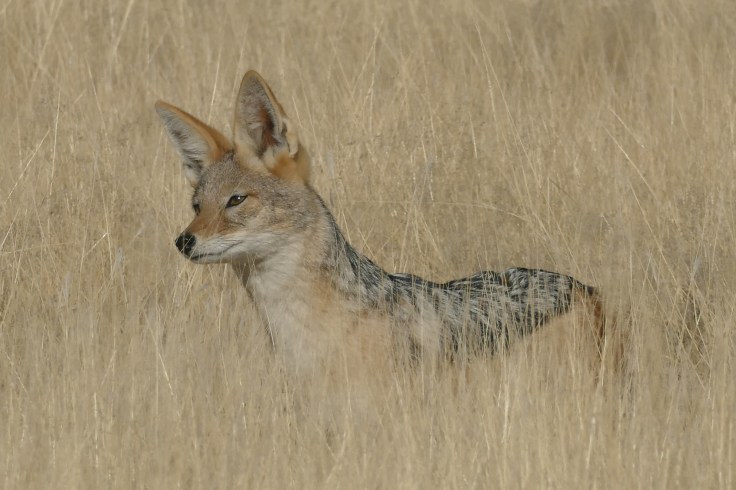
If threatend, jackals will rather retreat and find a place to hide than search the confrontation. On the other hand they have been seen mobbing larger predators, using specific calls to annoy them and eventually chase them away from a kill or their youngs.
Communication
Sound (Vocal) | Olfactory (Scent) | Tactile (Touch)
Late afternoon and in the evenings, listen for the distinctive wailing call of the Black-backed jackal which is mainly used to locate and communicate with family members and usually answered by them within a short timeframe.
Other vocalisations are used to call family members togethers (high-pitched, whining howl), to signal an intruder (frantic yelp), or to mob other predators, such as lions, hyenas or leopards (repetitive yapping). This call, once recognised, can be used as a reliable aid to find the large carnivore.
Territory size varies, depending on food availability and both guard their territory and scent-mark it with urine and the boundaries are reinforced with vocalizations. Scat is often found on exposed or elevated positions, such as grass or even other dung piles at the side of game paths or roads.
Reproduction & Lifecycle
Gestation: 2 months
No of young: 4
Weaning: 2 months
Sexual maturity: 11 months
Lifespan: 8-10 years
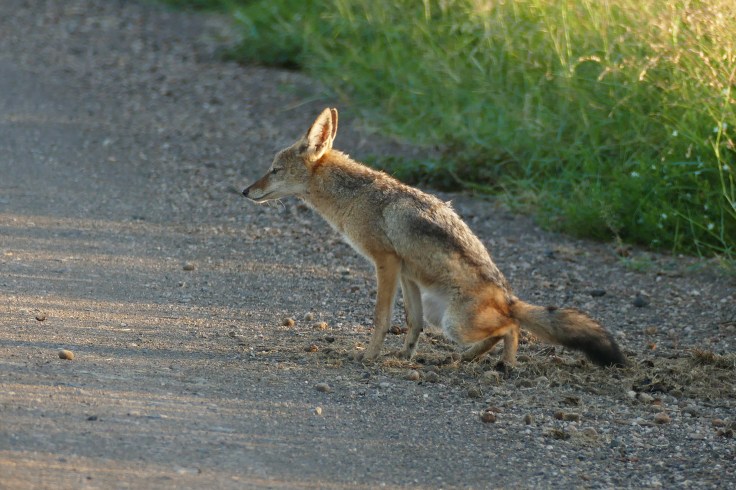
To give birth to and to raise their youngs, jackals prefer semi-elaborate burrows, e.g. from aardvarks, as long as the den allows for multiple entrances and escape routes. Pups are born blind and the eyes will open after about ten days. For the first three weeks, the youngs are suckled and thereafter fed on regurgitated food for up to three months. During this time, the family may move between several dens, to increase security but also in reduce parasite infestation insite the burrow. When moving, jackals do not carry their youngs as we know it from cats, but call them and the pups have to walk by themselves.
Male and female parents both take part in the rearing and feeding of young, although they often get supported by “alloparents” – typically older last year´s offspring, non-breeding females, or older males who bring mother and pups food and guard the den.
At about three months, the pups will leave the den and start foraging with the adults until they reach adulthood at about a year. They might leave their family unit at this point but may stay longer to help their parents raise the next litter of pups. In most cases, the litter shares the den with the parents for about two years
Diet
Omnivorous
Black-backed jackals are hunters and scavengers and feed on invertebrates (beetles, crickets, termites, millipedes), small rodents, hares, birds, reptiles, lambs, fruit, carrion and even small mammals, such as young antelopes, goats or sheep.
They do not mind stealing food from other animals, e.g. lion or leopard and are often seen around either a stalking predator or the kill itself, only waiting for the chance to sneak in and grab a portion. In this regard, they are a good indicator of predators around. Their main predators are Leopards, Hyenas and Eagles.

Did you know?
he Black-backed jackal plays a vital role in the ecosystem of its habitat. In some regions, where larger predators have been eliminated, the jackals have become dominant predators of the area. They choose prey according to their own size, catching sick or weak antelopes and thus maintaining the health of the ecosystem. In addition, the jackals scavenge, when there are carcasses. (Source: http://animalia.bio/black-backed-jackal)
Black-backed jackals are closely related to wolves and foxes.
In southern Africa, black-backed jackals are major carriers of rabies. This deadly disease peaks during the jackals’ mating season, killing adults and offspring. This threat to jackal numbers is increased by wildlife culls, which target jackals because they transmit rabies to domestic stock.
Jackals’ kidneys are structured to survive water deprivation, which allows black-backed jackals to thrive in very dry areas.
Top speed: 20 km/h.
Folktales & Traditional Stories
How Jackal got its black back
Caracal, Eland and Jackal
The day Jackal fooled the King of Beasts
Story of the Lion and the little Jackal
References
The Behaviour Guide to African Mammals, Richard Despard Estes
https://www.mpalalive.org
https://animaldiversity.org

 Sininho´s World
You must be logged in to post a comment.