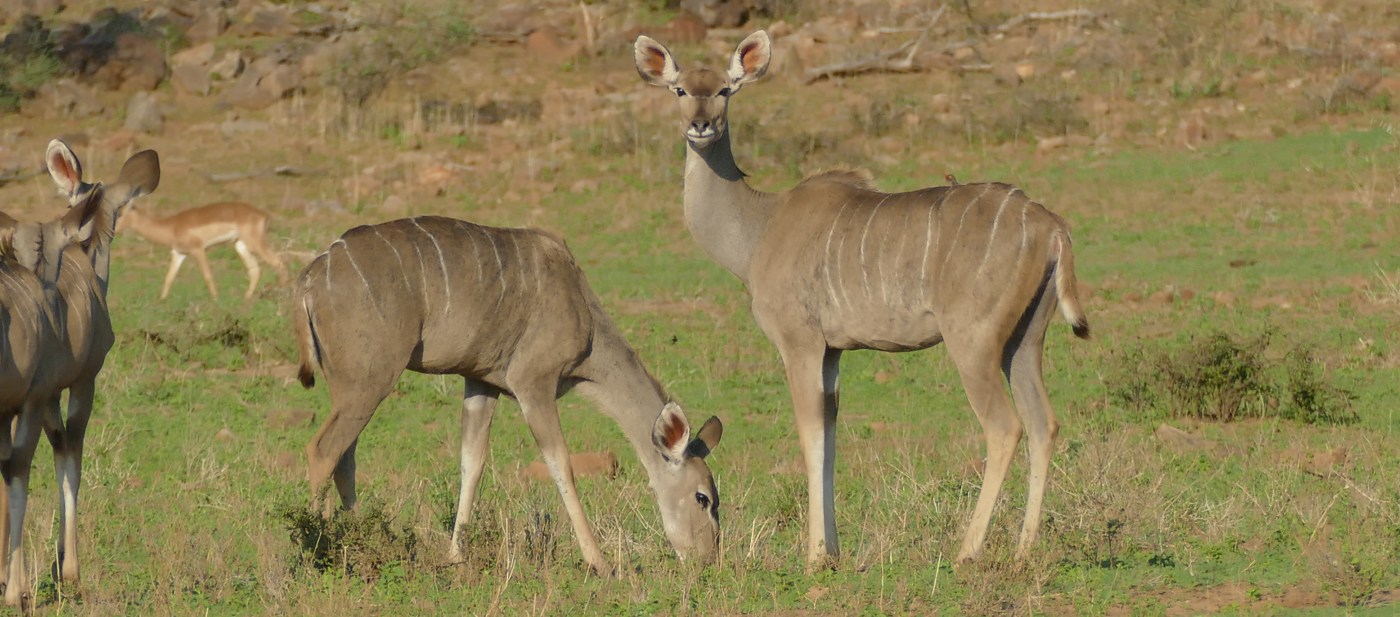
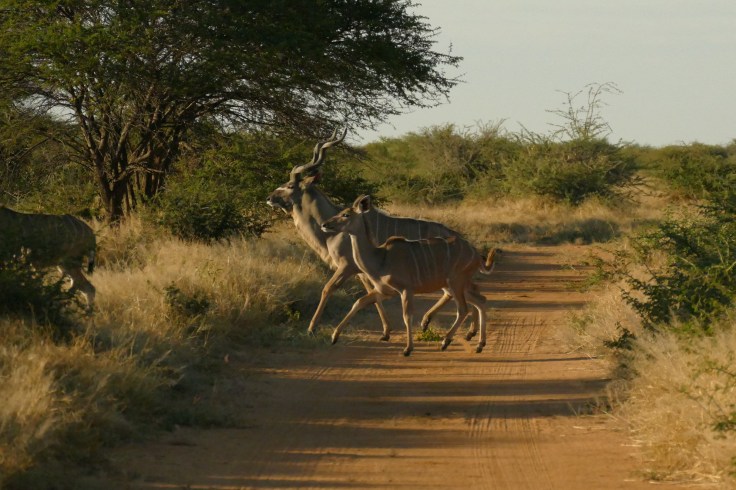
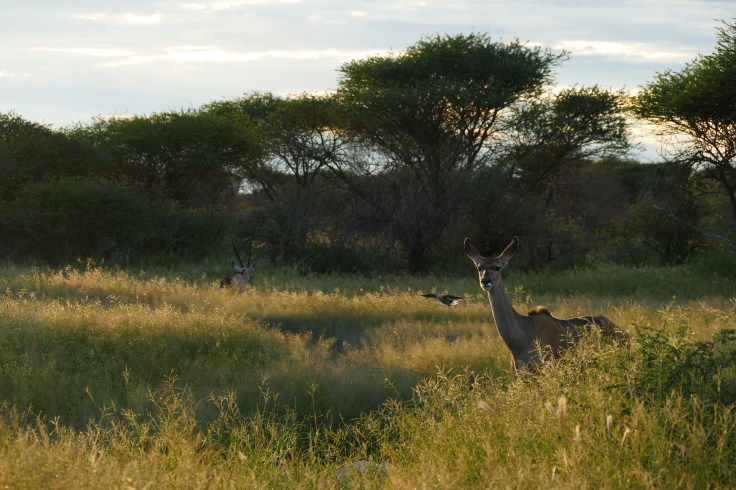
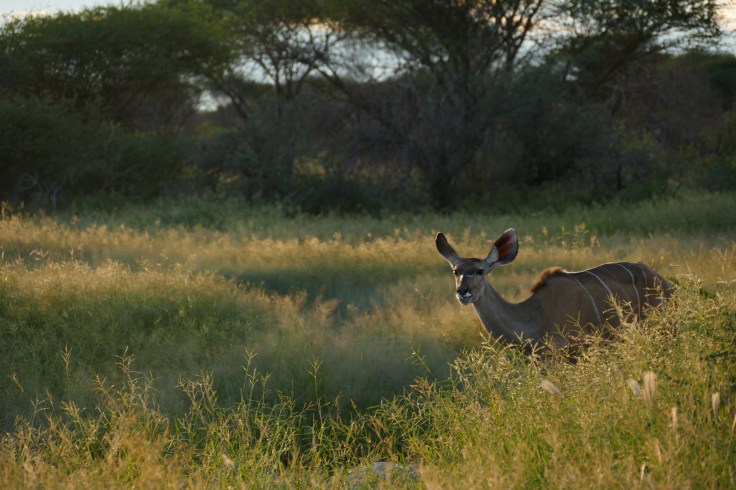
Now, look my friends, look at an animal from which our people learnt a very great lesson, a beautiful, though clumsy-looking animal. An animal with behaviour that caused our people to look upon it as the true symbol of the futility of war. This animal is a kudu, one of the largest and most beautiful antelopes in South Africa. In the language of the Zulu people, the kudu is called by the onomatopoeic name of Umgakla. Now, this name is formed by the sound that the clashing of the horns of two kudus locked in combat makes: ‘gakla, gakla,’ as the two great animals clash horns during the mating season.
Kudus fight ferociously at this time. You will see them charging each other like maddened knights of long ago, in the days of King Arthur’s Round Table. But something tragic often happens in these sylvan battles. The two animals sometimes fight so ferociously that their spiralling horns get locked into each other in such a way that the poor beasts can no longer disengage from one another. And both of them locked this way can neither feed nor seek water and are helpless before the fangs and the claws of predators. Again and again our forefathers saw this tragic sight – two great animals locked together imprisoned by their spiralling horns and dying in the bush.
“War,” my grandfather used to say to me, “is a game of kudus, grandson. In a war there are no winners really. Both victor and vanquished lose something precious, like two mad kudus fighting over females, ending up losing their lives in agony in the bush.” When an African parent warns his or her hot-headed offspring not to dash into conflict without thinking, the parent will say, “My son (or my daughter), remember the kudu, always remember the kudu.”
There is one thing that our people found in the kudu and it is that the kudu’s huge spiralling horns make amazing trumpets or bugles, which are used either by praise singers in chanting praise poetry for a king, or they are used in tribal fights to sound signals to advancing or retreating warriors. Whenever an African king or chief summons his elders and his warriors, he used to use a trumpet made out of the horn of a mature kudu. And the sound from this trumpet is really beautiful. It sounds as if more than one bugle is being played. It is a vibrating, thundering sound that can be heard over a great distance “hawooooooo… hawoooooo…” through hills and valleys, across plains and up mountain slopes, the sound of a kudu horn reaches everyone. Way back in 1934, I remember, I was a child. A strange tremor, a persistent trembling shook the entire land of the Zulus. And all people said that it was because God was angry with the Zulu people who had not, thanks to missionary intervention, celebrated the Incwala festival the previous year. On that day, when the sun grew dim in the sky, on that day, when mountains shook and valleys trembled, our grandparents pulled out ancient bugles from the dark interiors of their huts and they began to play them. From village to village, from kraal to kraal, went the sound of the kudu horn, “hawoooo… hawoooo….” People were pleading with God to be merciful towards them. People were appealing to the Great Spirit not to crack the earth open.
Source: Credo Mutwa
 Sininho´s World
You must be logged in to post a comment.