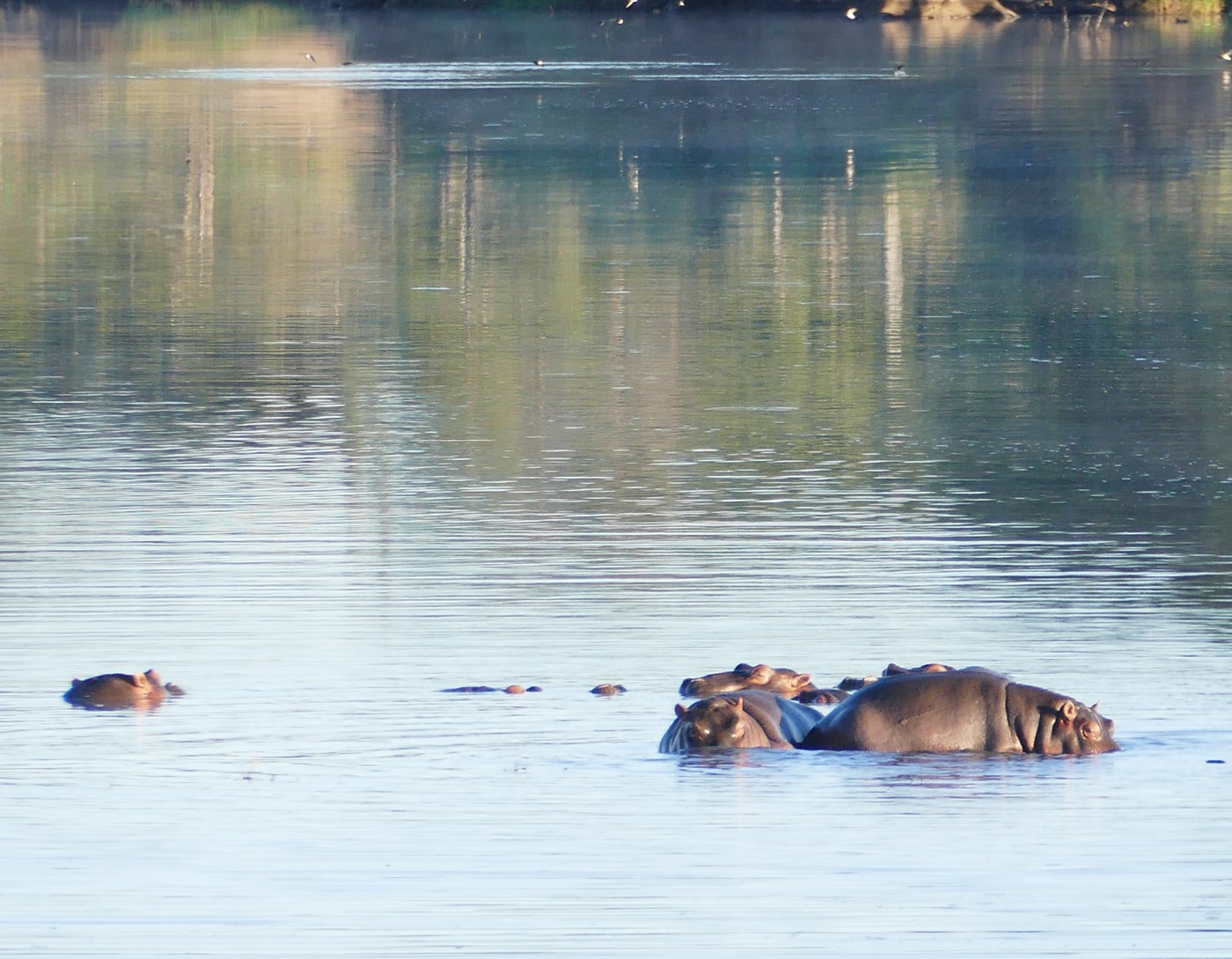
The hippopotamus is one of Africa’s most amusing animals. It is huge and plump like a gluttonous domestic pig. From a distance the hippopotamus looks large and beautiful, but it is a ferocious beast that needs to be treated with respect and only admired from a distance!
The Zulu people call the hippopotamus Imvubu, which is a very strange name indeed. It means the creature that is mixed, a creature that does not seem to have been able to make its mind up whether it wanted to be a rhinoceros or an elephant or whatever. Imvubu – the word comes from the verb vuba, which means ‘to mix together.’ In the language of the Batswana people, this animal is known as a Kubu, the animal of awaking. When a Motswana says, “I awoke last night,” he says “Kile ka kubuga malobobasigo.” The word kubuga means ‘to awake’ and you can see that the word has the name of the hippopotamus – Kubu – in it. Thus the literal meaning of the Batswana word for waking up is: to do like a hippopotamus, suddenly rising from the depths of the river to the surface, kubuga.
The hippopotamus is a sacred animal, according to my people’s religion. It is sacred to the goddesses and the gods of childbirth, all of whom are represented as having the heads of human beings and the bodies of hippos. One of our goddesses, however, is simply a hippopotamus walking on its hind legs. Her name is Matsala in Setswana, and Masala in Zulu – a name that is also used to refer to a mother-in-law, but one that means ‘the great birther’ or ‘the great bearer of children.’
Our people say that the hippopotamus is a symbol of laziness and selfindulgence. And a story is told of how it evaded a job, which the Great Earth Mother had given it, the rhinoceros, and the elephant when creation began, a job to pound the earth.
In the early years of cities such as Johannesburg, Zulu people used to refer to someone who avoided work – a loafer – as Imvubu, a hippopotamus. As with all animals throughout Africa, the hippopotamus is symbolic to certain peoples. There is a tribe of people in Botswana, who regard the hippopotamus as their totem – they are known as the Bakubung, which means ‘the people of the hippopotamus (It is the name given to one of the lodges in the Pilansberg Reserve)’ In olden days these people protected hippos with their lives, and they never killed a hippopotamus, no matter what destruction it wrought in their villages and with their crops.
But, should a hippopotamus persistently kill people in the land of the Bakubung, the Bakubung used to employ the services of professional hunters belonging to another tribe, to get rid of the rogue hippopotamus. Once the animal had been killed however, these foreign hunters had to run for their lives, because the king of the Bakubung was bound by law to send warriors to pursue and to kill the hunters who had killed the tribe’s sacred animal. The hunters had to run as fast as they could, and to get back to their tribe land as quickly as they could where they would be safe. And should they manage to escape, the king of the Bakubung used to send cattle to the hunters’ homeland as a reward for what the hunters had done.
Source: Credo Mutwa
 Sininho´s World
You must be logged in to post a comment.