Gemsbok (Oryx)
Oryx gazella
Description, Habitat & Distribution
Lifestyle, Behaviour & Social life
Communication
Diet
Reproduction & Lifestyle
Did you know?
Folktales & Traditional Stories
Description
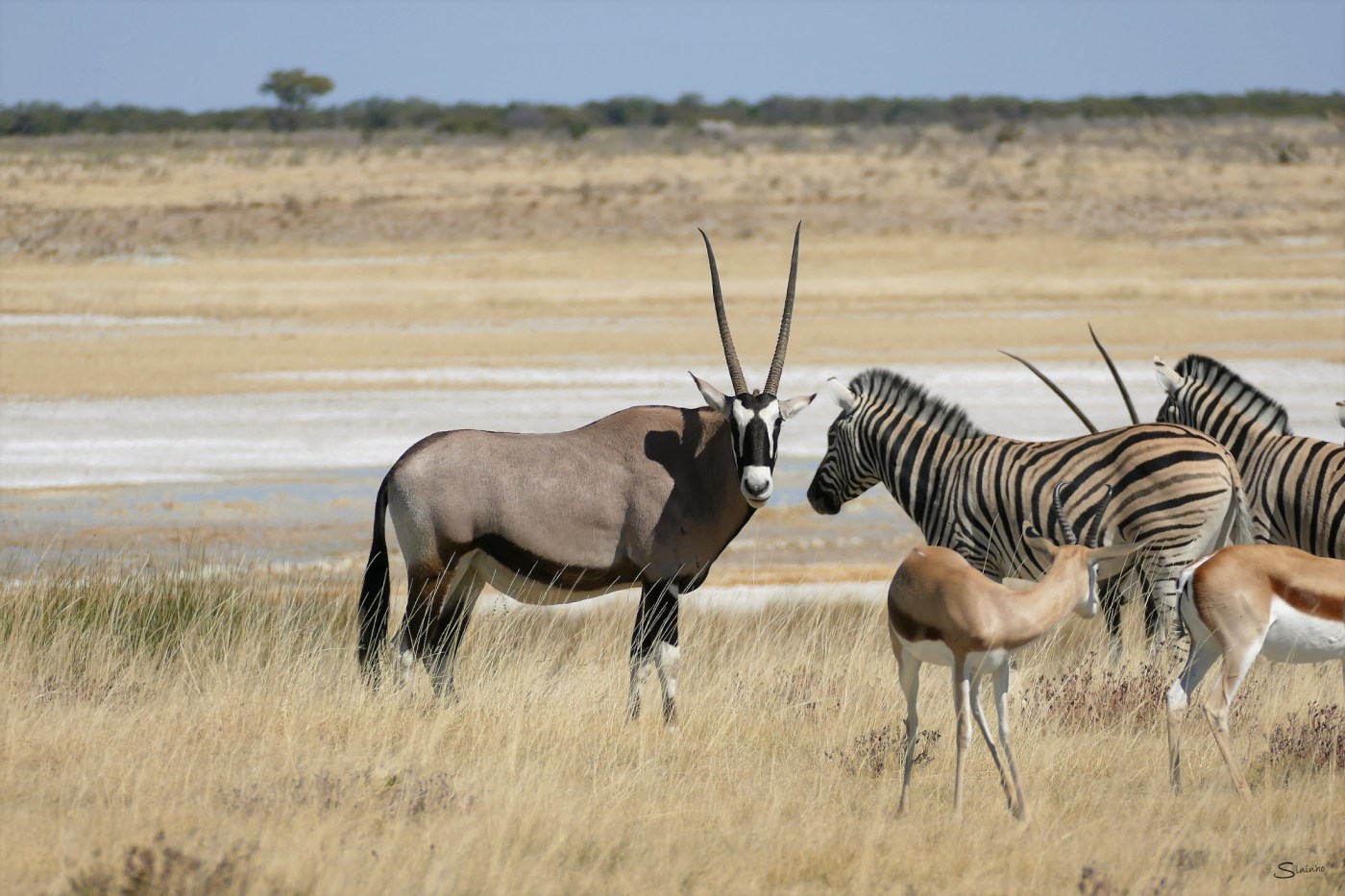
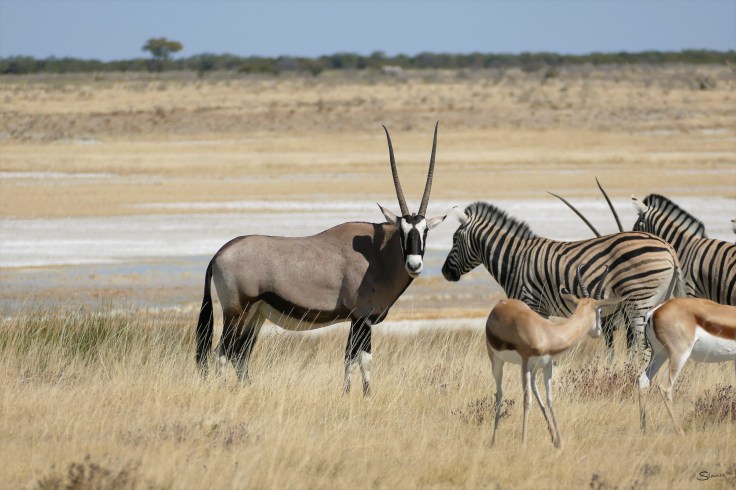
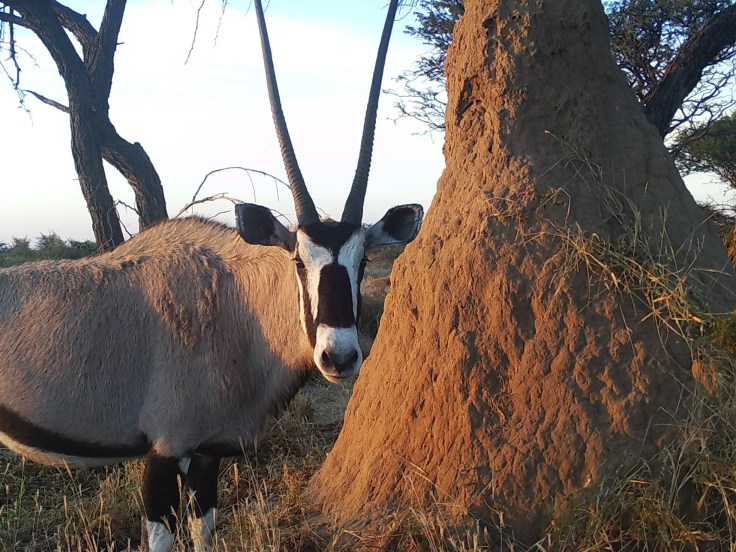
Large, powerfully built antelope with distinctively black and white markings on the face and long lance-like horns in both sexes. The body is pale fawn-grey coloured with white underparts and a black stripe down the spine and on the rump. A black band runs along the lower part of the body, nicely framing the shape.
Sexual dimorphism
Males and females look similar but horns in females are slenderer.
Habitat
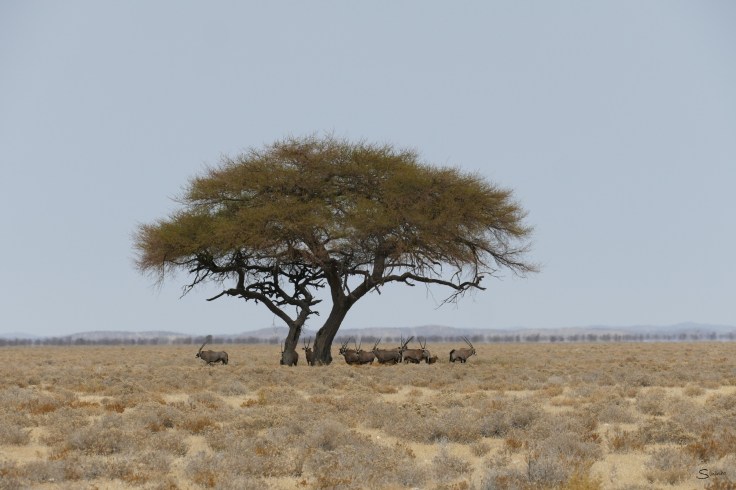
Arid and semi-arid open grassland, scrub, light open woodland, penetrating into the savanna woodland.
Distribution
Southern east Africa, though formerly the range included South Africa.
Lifestyle, Behaviour & Social Life
Gregarious | Territorial / Non-territorial | Diurnal
Daily routine
Gemsbok are gregarious antelopes that live in herds in dry and arid conditions. They are well adapted to their habitat and survive on small amounts of water.
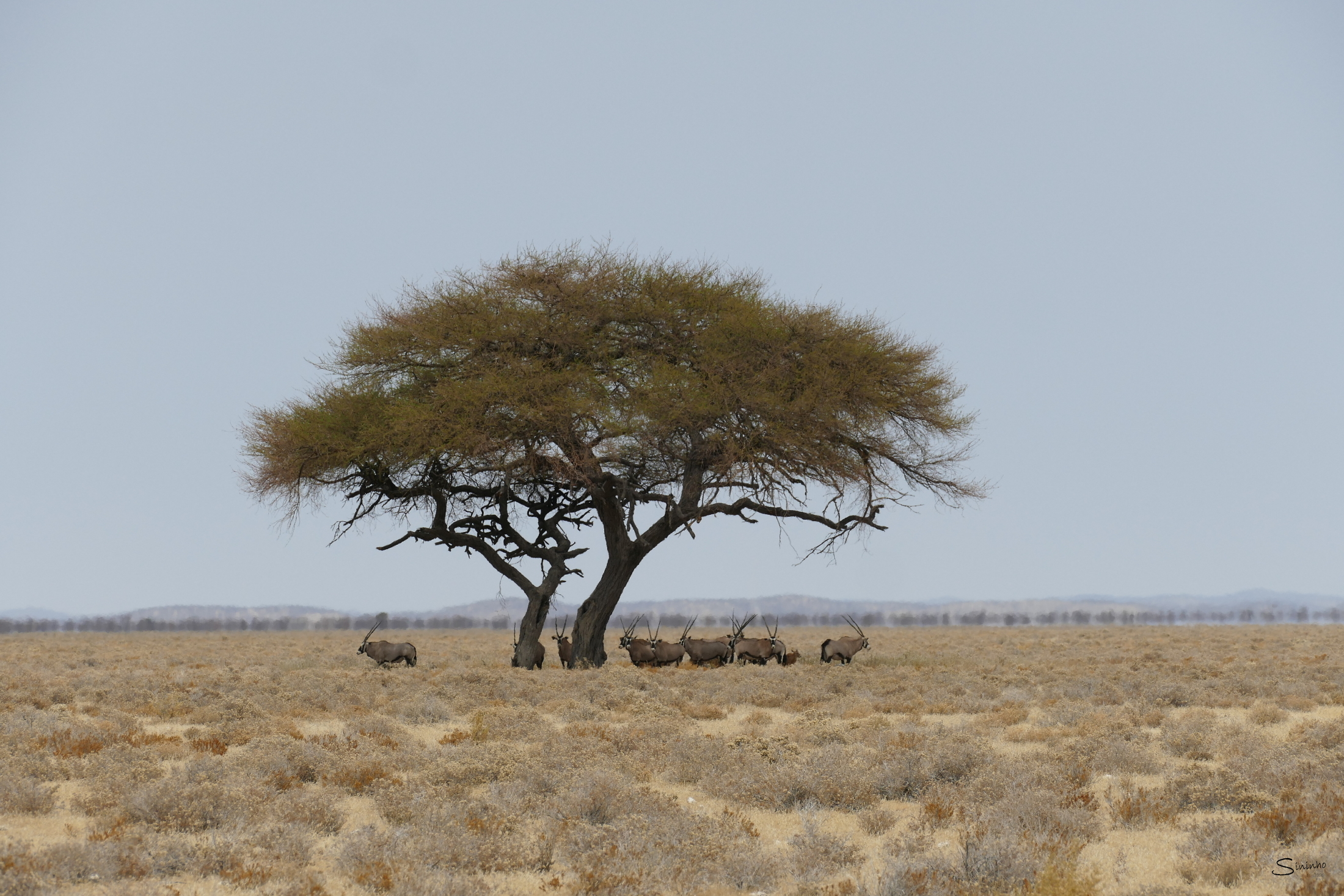
Gemsbok (Oryx) are mainly crepuscular animals, meaning they are most active at dusk and dawn. Although they remain active during the day, they will stay in the shade for large parts of the day (the hottest ones) and graze at night when it is not that hot, and the moisture content of the vegetation is higher. They will thus feed in the early mornings when there is due on the leaves of the vegetation, or even at night when the plants also have a higher moisture content.
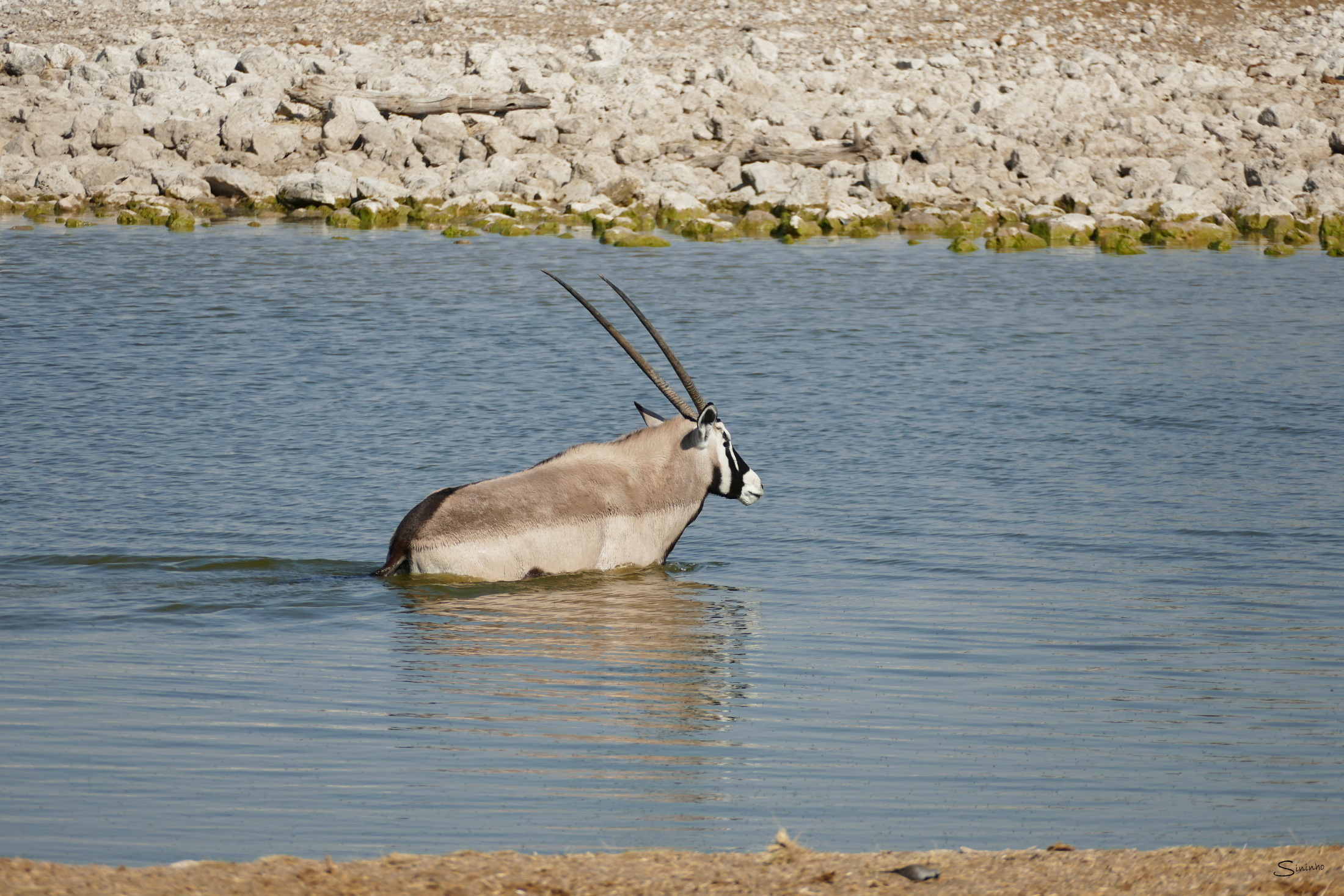
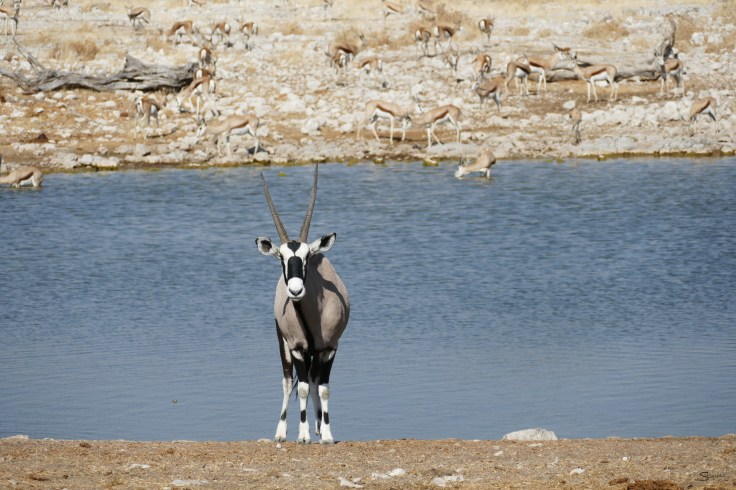
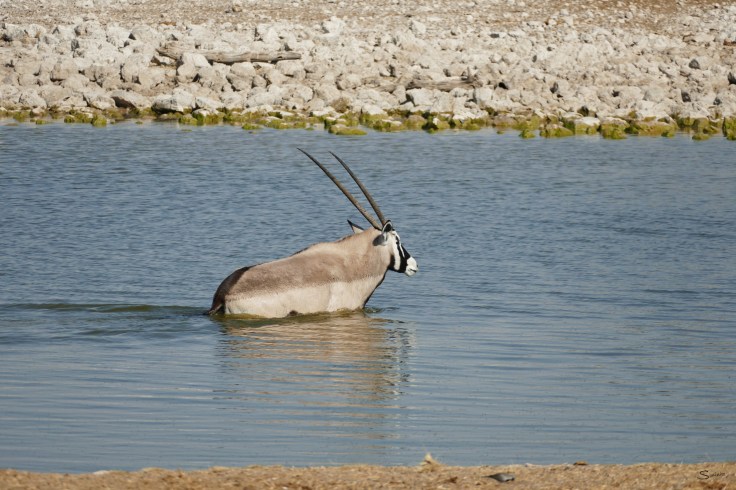
They can go without water for a long time but if water is available, they are regular seen drinking and cooling down.
Gemsbok (Oryx) are mainly crepuscular animals, meaning they are most active at dusk and dawn. Although they remain active during the day, they will stay in the shade for large parts of the day (the hottest ones) and graze at night when it is not that hot, and the moisture content of the vegetation is higher. They will thus feed in the early mornings when there is due on the leaves of the vegetation, or even at night when the plants also have a higher moisture content.
They can go without water for a long time but if water is available, they will drink or go for a “swim” to cool down.
Social life
Gemsbok live in mixed groups of different sizes and with a separate dominance hierarchy for the males and females: dominant male is at the top, followed by the dominant female. In large groups, there may be a second-ranked male, called a beta male. The dominant male will lead by aggressive displays (although physical contact is usually minimal). This hierarchy remains intact until a water scarcity, at which point the males take precedence over all females.
In smaller group, however, composition can consist of all females and young (nursery herd), females with one male (harem), or all males (bachelor herds).
| Harem life Territorial bulls hold a territory of four to ten square kilometres where they gather a harem of cows from passing herds of females. Their territory is marked with small heaps of dung, with urine, by rubbing against plants and marking them with scent from their cheek glands, and by pawing at the ground and marking it with scent from glands on their hooves. Young bulls are allowed to share the territory, provided that they don’t attempt to seduce the other bull’s cows. If the young bull does attempt to seduce the cows, the dominant male in the area will make an aggressive display with its horns to scare away the young bull. |
Antipredator behaviour
These animals are very alert and their primary response to threat is flight although their horns are dangerous weapons and they will use them for defense if they have to. As they live in herds, more eyes see more and whenever a group of gemsbok is seen, at least one head is up to screen the environment. As soon as a predator is spotted, body posture becomes tensed and usually an alarm snort is given to inform the the rest of the herd. Gemsbok, like most antelopes, also respond to alarm calls of other antelopes (like zebra or impala) which gives an additional advantage of vigilance.
| I once watched some lions behind a water tank close to a water hole in the Etosha NP. They were not really hiding, more resting in the shade and they did not care if their prey species could see them or not. And they did. Springbok, zebras, and gemsbok were on the way to the water when they discovered the lions and all of the animals responded with stopping, watching, and alarm snorts. As the lions got up at one point, the gemsbok (as the other antelopes) snorted again but then did not hesitate to run into a safe distance where they then turned to again have a look to what the predators were doing. |
It is not always a successful stategy though …
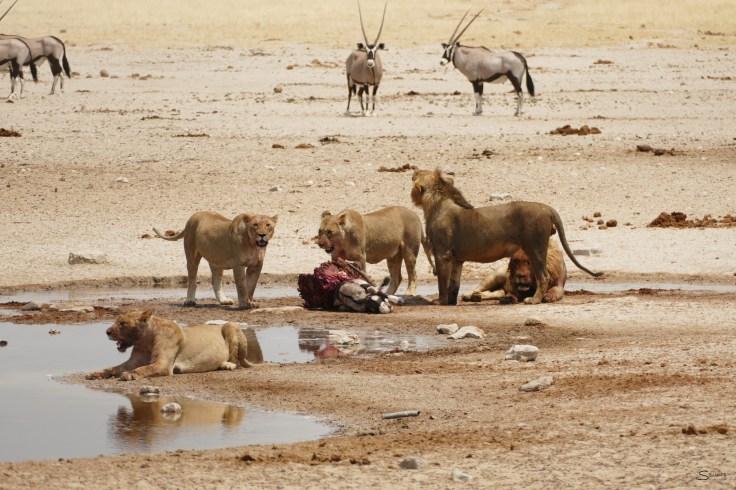
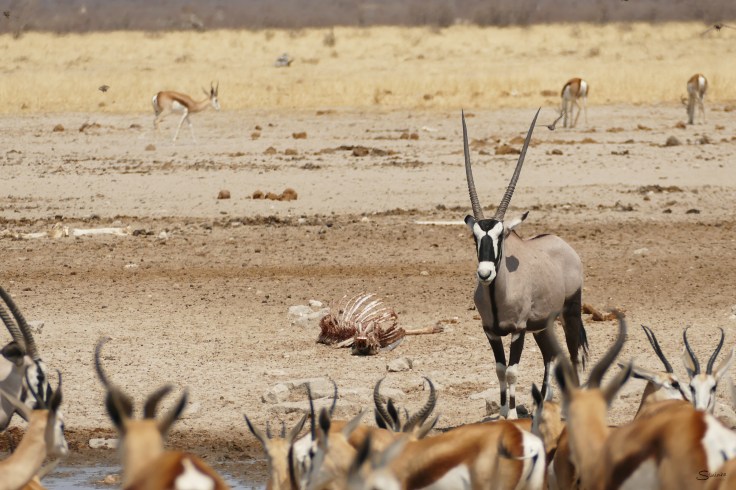
Gemsbok caught by a lion pride (Etosha NP, October 2020)
Their main predators are Lion, Spotted Hyena, but also Cheetah and Leopard.
Communication
Sound (Vocal) | Touch (Tactile) | Visual (Sight) | Chemical (Smell/Scent)
The most communication that can be observed is when an individual or the group is alarmed (body posture and alarm snorts), dominance display behaviour in males (bulls roar during fights), or tactile communication between a mother and her calf.
As in other animals, scent also plays a role to transmit information. Dung piles and urine are mainly used to transmit information about the reproductive status of females or the presence of a dominant male. In addition, scent-marking (by scent glands in the hooves) is used as chemical data transport system.
Reproduction & Lifecycle
Gestation: 8.5 months
No of young: 1
Weaning: 3.5 months
Sexual maturity: 2 years
Lifespan: 18 years
Gemsbok have no specific breeding season, but females synchronise breeding which serves a better protection of the offspring.
During courtship, males will show dominance and involve themselves in territorial combats. Horn clashing with other males and snorting can be observed more regularly in this time. If a female is in estrus will be urine-tested and if so, the male starts following her with erect body posture and foreleg-lifting.
Females isolate themselves before calving afer a gestation period of 8.5 months. Gemsbok calves are hidden for the first few weeks (3-6), born without horns and brown in colour, which serves as camouflage for a better protection for the first time of their vulnerable life.
The young are weaned at the age of 3.5 months and become independent at about 4.5 months. While males disperse, the females stay in the maternal herd.
Diet
Herbivorous
Gemsbok are grazers but will browse when grass is not available. They will also feed on roots, bulbs, tubers, tsama melons and gemsbok cucumbers which provides them additional moisture and they can regularly be seen eating soil and salt at water holes to add nutrients and minerals to their diet.
Did you know?
Gemsbok exploit areas that few other animals can inhabit; they tend not to interact with many other species (although seen with other antelopes, especially at waterholes which might also be just coincidentally). Also, because they are nomadic, they tend not to overgraze areas. In regions of the North American Southwest where gemsbok (and other exotic species) have been introduced, overgrazing has occurred, leading to the degradation of the areas populated by these herds. (Boomker, et al., 2000; Boomker, et al., 1986; Horak, et al., 1992; Allen, et al., 1997)
Oryx are exceptionally well equipped to survive in the driest of areas and can go without water for long time (although I see them drink regularly if water is available).
To cope with the high temperatures, they have different strategies: Seeking shade or a breezy spot is one of their tactics but more fascinating are the ones that are not so obvious. One is the carotid rete system. It fools the brain and pretends the body does not need cooling. In addition, heat from the blood is dissipated in the nasal passage, therefore cooling down on its way to the brain and avoiding brain damage that usually occurs at temperatures above 43°C. Beside those mechanisms, gemsbok also save water wherever possible. Their diet provides them a good base for moisture intake, and to prevent loss of water, the urine is highly concentrated and the Oryx’s´ droppings are very dry. In the Etosha NP, I regularly see gemsbok walking and resting in the Etosha Pan where for kilometres no water is in reach and temperatures easily go above 45°C during the day.
Gemsbok males crouch when defecating which creates a neat pile dung that preserves scent by staying moist for longer.
The Oryx is naturally protective creature, yet it does not attack unless necessary. It is amiable but ready to defend at all times. As a totem, the Oryx shows us the strength we need to protect ourselves and those we love, but it also shows the wisdom we need to discern when we need to do so.
Top speed: 60 km/h.
Folktales & Traditional Stories
None yet 😦

References
The Behaviour Guide to African Mammals (Richard D. Estes)
Beat about the Bush (Trevor Carnaby)
http://www.tourbrief.com
 Sininho´s World
You must be logged in to post a comment.